How data product marketplaces drive more effective data governance
Effective data governance is now critical to both protecting information, and enabling its secure consumption across the business. We look at how to structure governance to deliver success and the role that the data product marketplace plays in data democratization.

In the past data governance programs have been reactive, designed to reduce risk and ensure compliance. This is now changing dramatically. In today’s data-driven organizations, effective governance is no longer a back-office function – it is a strategic differentiator. Companies that can manage, curate, and share data responsibly internally and externally are able to accelerate decision-making, unlock new insights, and generate tangible business value.
All of this makes how data governance and data teams are structured business-critical. Ensuring that models match business needs and ensure that data is easily available, yet securely governed, is vital to success.
Based on our experience working with a wide range of clients and projects, this article explores different potential governance models, outlines the steps organizations should take to move from decentralized data to structured frameworks, and illustrates how a data product marketplace is central to democratizing data access, empowering business teams, and scaling value across the organization.
The transforming data governance landscape
As data volumes have grown in their size and importance, ensuring that all data assets are well-governed and protected has become central to the Chief Data Officer (CDO) role. The financial and reputational risks of data breaches or non-compliance with laws such as the GDPR and CCPA are well-understood across senior management.
However, for data to deliver value, robust governance has to be combined with providing secure, intuitive access to data, internally and with key partners. This requires a balancing act between security and openness when it comes to data sharing and governance.
At Huwise, we work with a wide range of clients, across sectors and countries. How they treat data governance varies. Some have highly centralized data teams, while others are experimenting with decentralized or democratized data models. Whatever model they choose, over time, we’ve observed patterns in how organizations structure governance, manage responsibilities, and scale access to data across business teams. These insights provide a clear framework for thinking about data governance, highlighting what works, the challenges that can arise, and how governance can evolve to meet the demands of modern, data-intensive organizations.
Governance models in practice
Data governance within organizations is a journey, not a destination. How it is handled and the structure and processes behind it evolve over time, due to factors such as data maturity, adoption of data products/AI, and the need to increase data consumption to drive value. There are three broad models, each of which has benefits and potential challenges that need to be understood.
1. Centralized data team
In this model, the central data team manages, curates, and publishes all data assets, ensuring consistency, accuracy, and compliance. No-one within departments or the wider business is involved in management or governance – they are purely consumers of these data assets.
Benefits: strong governance, standardized practices, clear accountability, and a reduced risk of errors.
Challenges: can be difficult to scale as data volumes grow, overwhelming the central team’s resources. The lack of involvement of the business can undermine buy-in and engagement, meaning data consumption does not spread.
2. Business-led data management (data mesh)
Data is managed within business teams, either under the oversight of a central data team or through cross-departmental committees. This federated data management model is a core pillar of the data mesh methodology.
Benefits: workload is distributed across the organization, closer alignment with business needs, faster decision-making, empowerment of business teams, and a culture of ownership.
Challenges: without strong guardrails inconsistencies in how data is managed can occur, and there can be unclear boundaries between departments and the central data team, leading to potential overlap and duplication.
3. Power user involvement
In this structure, power users from within the business are allowed to publish and curate data, while the data team retains overall responsibility for governance and quality.
Benefits: faster updates, reduced dependency on data experts, shared responsibility, inclusivity, stronger data culture, data is managed by those closest to it, and accelerated innovation.
Challenges: as with business-led data management strong processes are needed to ensure consistency. Power users may be dispersed unequally across the business, leading to gaps in particular, important, areas and departments.
From decentralization to a structured governance framework
Organizations typically evolve through multiple steps before achieving structured, operational governance. In the early stages, their data and its management is often decentralized, with data produced and used in departmental silos, without any central understanding of the overall data landscape. As maturity increases structures are developed, following a clear three step process:
Map the current landscape
Begin by building an understanding of the data estate. inventory datasets, identify priority use cases, and map key stakeholders.
Define clear roles and responsibilities
Once the organization has mapped its data landscape, it can then define clear roles and responsibilities and implement pragmatic governance rules aligned with business priorities. These rules and processes need to involve the entire business and be supported by senior management if they are to deliver engagement and adoption.
Standardize, secure, and sustain data management
Once the foundations of a governance structure is in place, processes and tools can be deployed to operationalize data governance and management. The goal is not to constrain teams, but to build a trusted framework that fosters data quality, accessibility, and value creation across the organization. Its effectiveness needs to be monitored and structures reviewed and adapted as needs change and data maturity grows.
How a data product marketplace supports governance and unlocks data value
Successful governance must be combined with delivering secure access to data to drive its consumption and value. Data product marketplaces are crucial to this aim, providing a dedicated, intuitive layer to consume, promote, and govern all of the organization’s data assets and products.
Data product marketplaces go far beyond data catalogs, which simply provide an inventory of data assets. They are more than a centralized repository, instead acting as a strategic enabler that democratizes access to data, empowers business teams, and scales usage across the organization while ensuring governance and security. An intuitive, e-commerce style interface makes it easy for all users to discover, trust and consume the data they need, without requiring technical skills.
Key data product marketplace governance capabilities include:
- Enhanced security: Multi-Factor Authentication (MFA) and Single Sign-On (SSO) ensure tight control over data access, simplifying identity management by aligning with corporate standards while protecting sensitive information.
- Strict access control: datasets can be fully public, private or shared only with specific users or groups, keeping confidential information secure and invisible to unauthorized individuals.
- Flexible workflows: business users can share new data assets or access datasets through intuitive workflows, with approvals managed by administrators to ensure governance and compliance through complete audit trails.
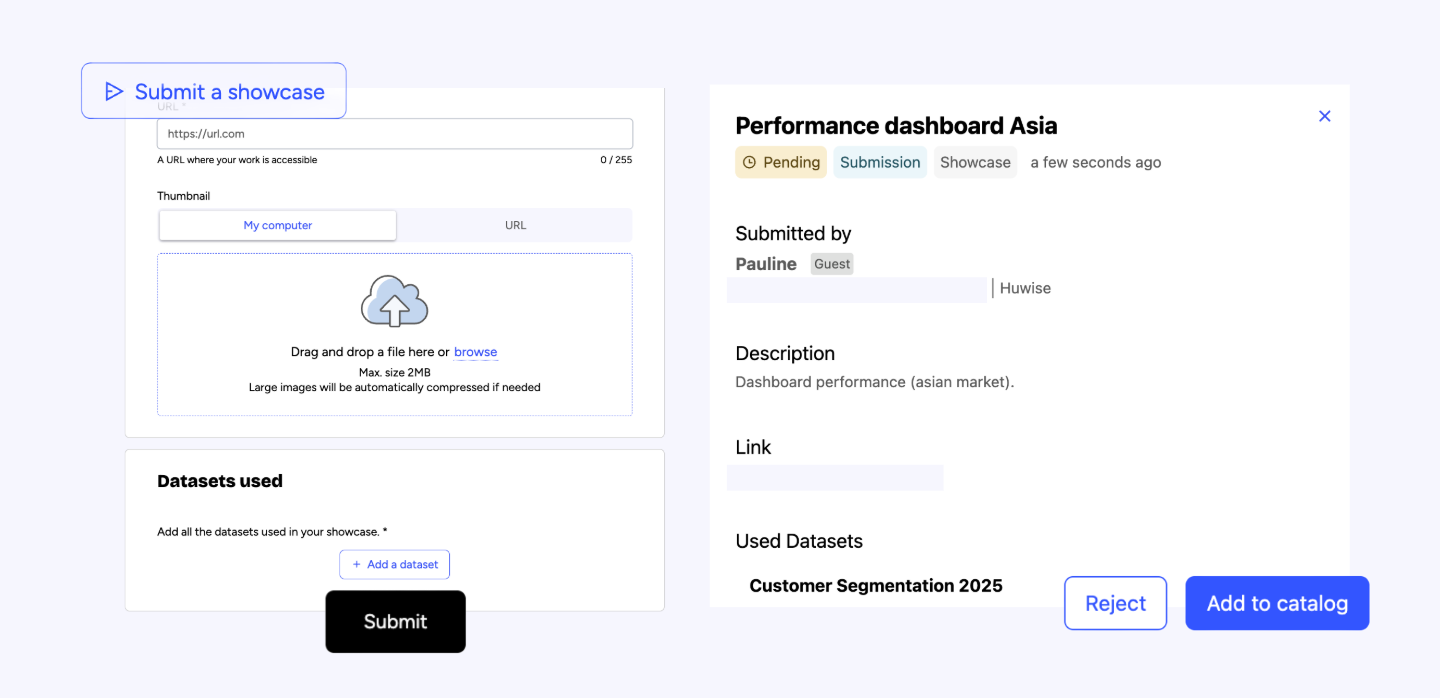
- Collaboration between business and data teams: even with restricted access, users can easily contact and question dataset owners, fostering cooperation and knowledge sharing without compromising security.
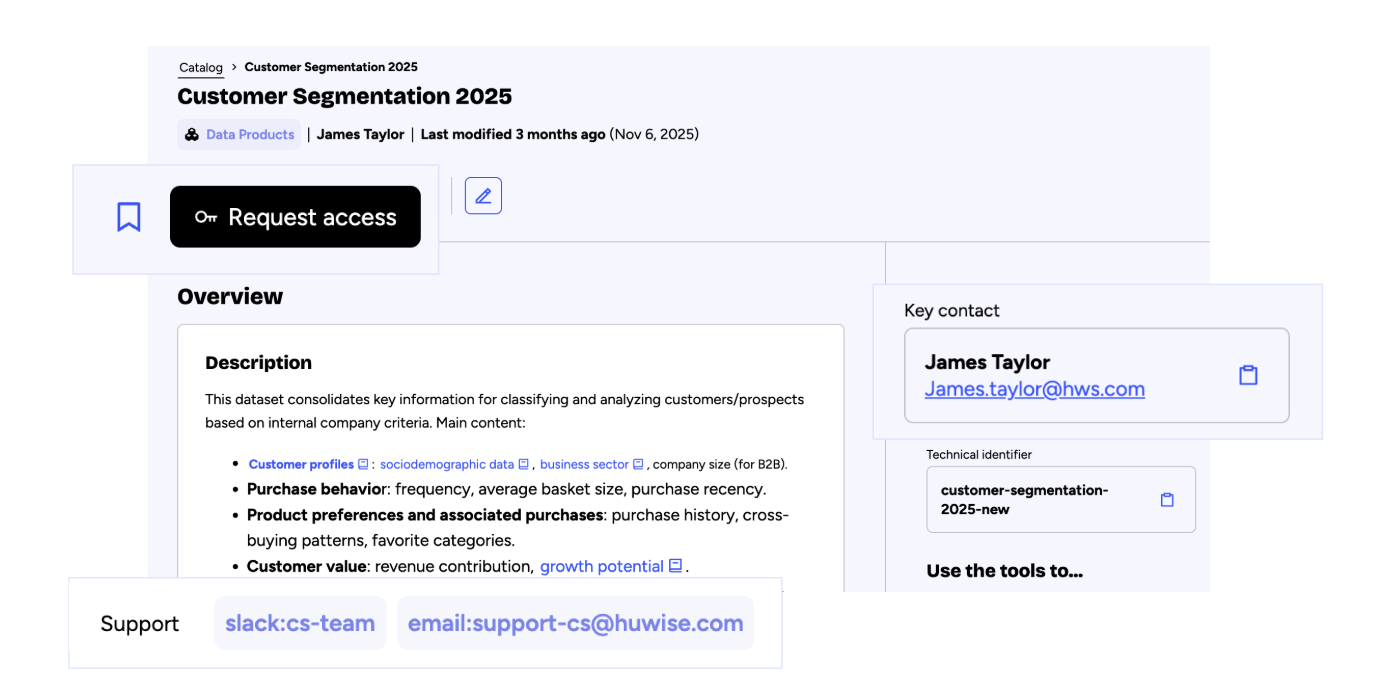
- Granular user and group management: data governance teams can assign precise access rights to individuals or groups, allowing fine-grained control over who can view, edit, or use each dataset.
By combining security, flexibility, and collaboration, the data marketplace allows organizations to share data responsibly, scale adoption, and generate value, while maintaining oversight and compliance.
Measuring governance effectiveness
Data product marketplaces must also provide key metrics on the effectiveness of data governance programs. For example, to track progress, the Huwise platform monitors and reports on four categories of KPIs:
- Data quality: dataset completeness, duplicate rate, compliance with governance standards
- Usage and adoption: number of data assets and data products actively used, access requests processed
- Process and organization: role compliance, governance rules implemented versus planned
- Strategic/business: value generated from data, reduction of data-related risks
Roadmap: towards more granular, scalable, and strategic governance
Huwise already provides a strong foundation for data governance through its data product marketplace. However, accelerating usage, growing internal data sharing, the increasing complexity of internal user requests, and rising data volumes will require much more sophisticated capabilities moving forward.
Consequently, our roadmap aims to create a precise, modular, and value-oriented framework, making governance concepts visible and actionable, enabling clear delegation of responsibilities, and giving administrators comprehensive visibility and management capabilities.
As part of this, governance will feature a finer level of access control based on the Principle of Least Privilege (PoLP), where users are granted only the minimum access rights and permissions necessary to perform their specific tasks, along with a robust and scalable technical foundation that can support evolving roles, policies, and organizational complexity.
Driving data value through governance
As increasing data access and use becomes central to competitiveness, organizations need to develop data governance to ensure it supports changing business needs, while protecting and securing information. Whichever governance model is adopted, underpinning it with a data product marketplace ensures that data governance is not just a compliance exercise but a strategic lever, enabling organizations to scale data usage safely, accelerate insights, and maximize the value of their data assets.
Share this post:
Articles on the same topic:
About the author

Audrey Malherbe
Audrey Malherbe Product Manager, Huwise Audrey Malherbe est Product Manager chez Huwise, où elle développe des innovations au sein de la Squad Engagement.
More articles