
KYC: From regulatory constraint to growth driver through data product marketplaces
KYC (Know Your Customer) and KYS (Know Your Supplier) are core regulatory requirements for financial institutions. While necessary, compliance is often seen as an administrative, legislative burden and a complex, siloed cost center. Thanks to the explosion in data volumes, the complexity of ownership structures, growing international sanctions, and increasingly strict regulations that vary between countries, organizations are finding it hard to cope if they rely on manual processes to ensure compliance.

However, the constraints imposed by KYC can also be viewed as a genuine opportunity. When managed effectively with the right tools, KYC allows organizations to support their business objectives while avoiding the severe consequences (including fines, legal cases and financial losses) that can result from poor compliance management.
Today’s KYC challenge is therefore no longer simply collecting data, but centralizing and analyzing it at scale. This is where data product marketplace solutions come into play. They underpin an ecosystem where compliance data is no longer a raw data file, but a complete, certified, and immediately actionable data product delivered to business teams through ready-to-use applications.
The problem: traditional KYC processes are costly and inefficient
Organizations have reached the limits of manual approaches when it comes to managing KYC processes. Demonstrating this, financial services employees today spend more time searching for and gathering the necessary data than actually analyzing it.
Handling KYC manually is inefficient and requires significant resources. It can create numerous issues and lead to major costs, including through:
- Data entry errors, corrections, and recurring quality control processes
- Reliance on dedicated experts to review, compare, and validate each document
- Time lost gathering all information required for analysis
- High training, infrastructure, and management costs, reducing overall efficiency
- Excessive processing times and a degraded user experience for business teams
- Risk of fines due to fraud going undetected because of human errors
The speed and performance requirements inherent to KYC demand a more efficient and automated approach. This is exactly what data product marketplaces enable for financial services organizations.
The data product marketplace: transforming KYC through ready-to-use business applications
Data product marketplaces make it possible to centralize multiple data sources and share them as understandable, secure, and traceable data products. Given that one of the biggest challenges to KYC processes is fragmented data sources, this is a major business benefit.
Dedicated business applications for KYC management
The main advantage of data marketplaces such as Huwise lies in the ability to build business applications on top of this foundation, transforming data into a product that can be directly used by operational teams.
Real-world example: a business application for easier credit approvals
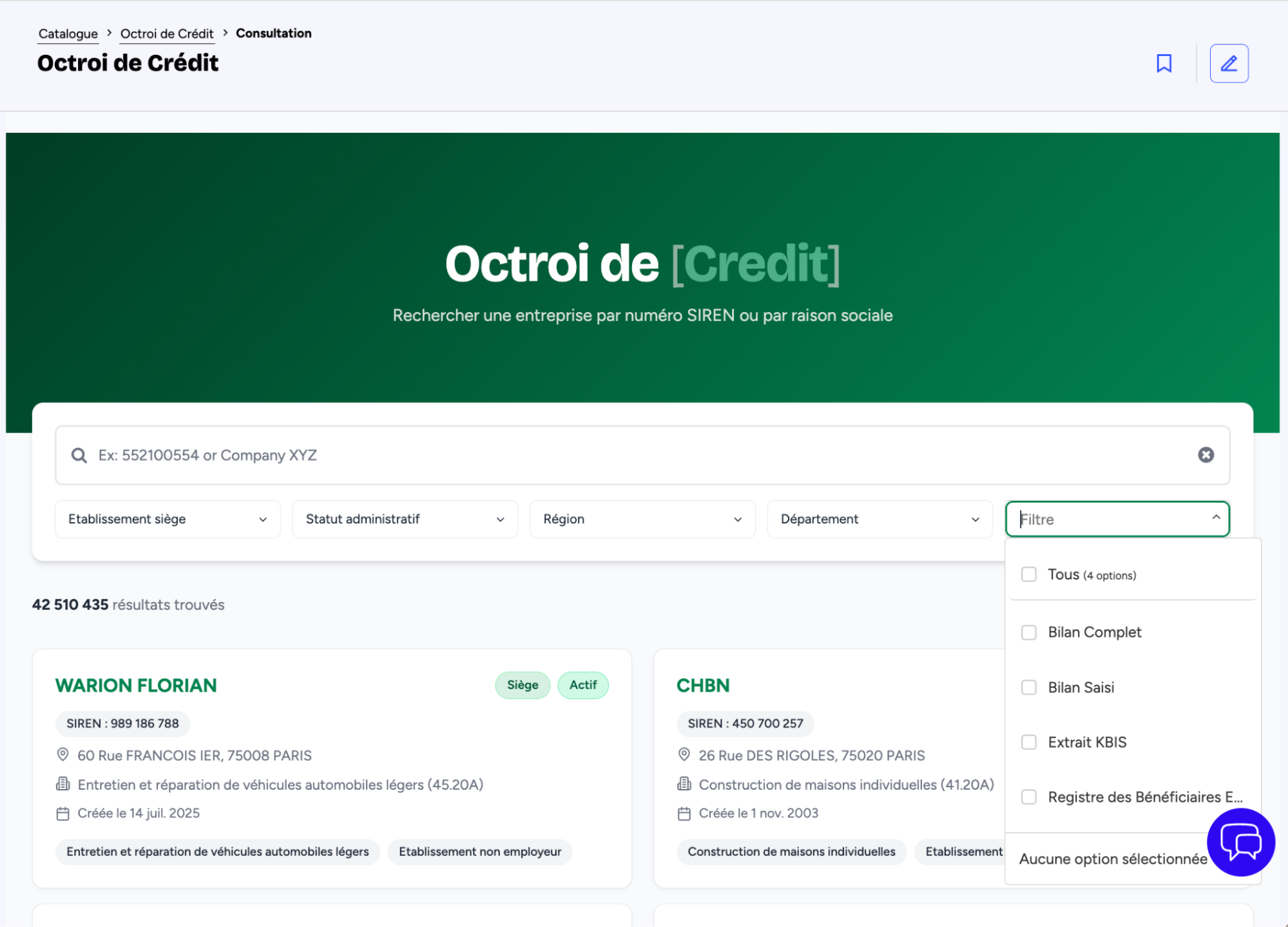
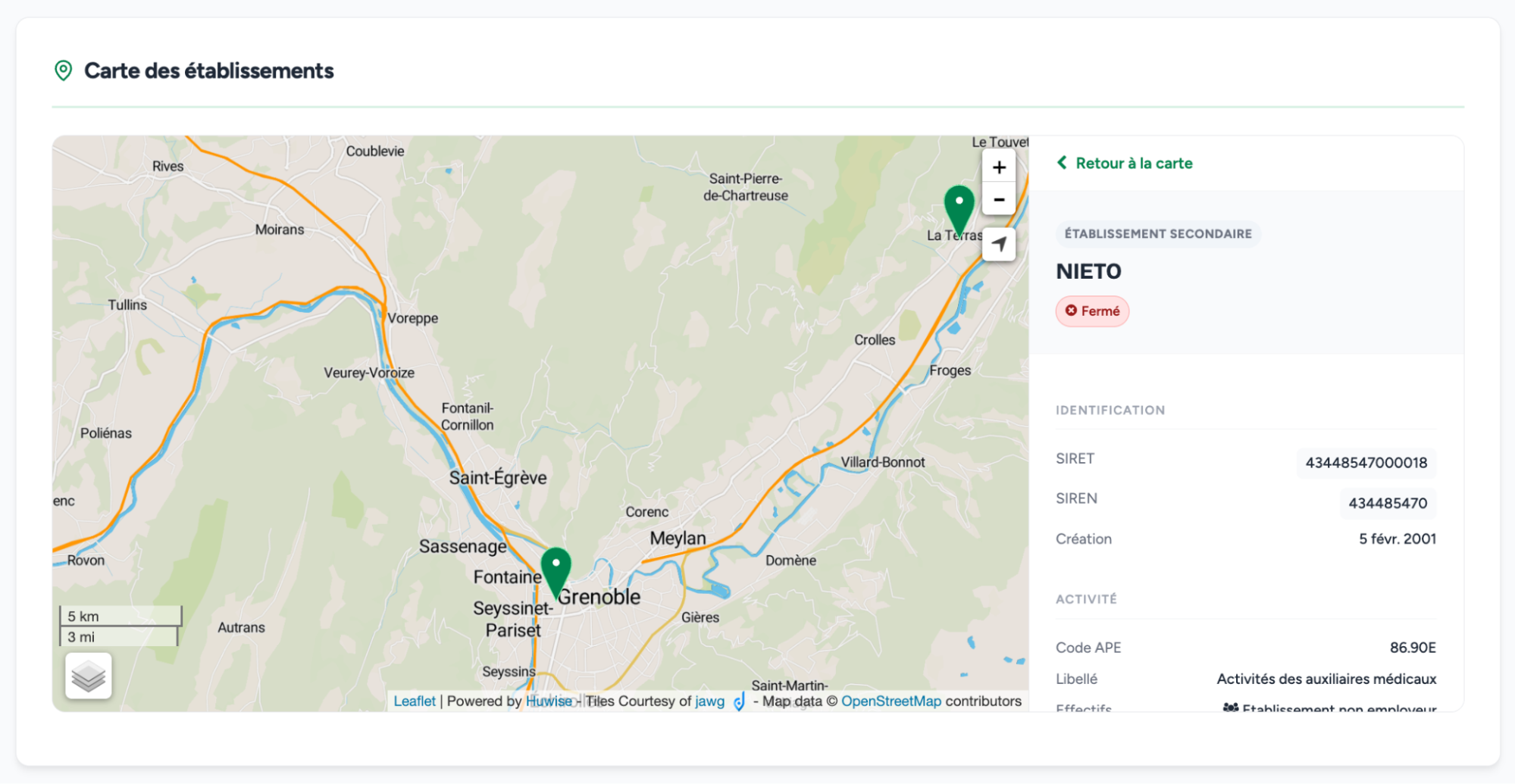
Built and hosted within a Huwise data product marketplace, this application provides a consolidated view of a company’s financial and administrative information using its company number. Within the data marketplace, legal data is continuously updated and readily available to employees.
The key information required for KYC checks is therefore available to staff through self-service, including annual financial statements, tax balance sheets, beneficial ownership information, and structured analyses (such as revenue trends, profitability, and risk indicators).
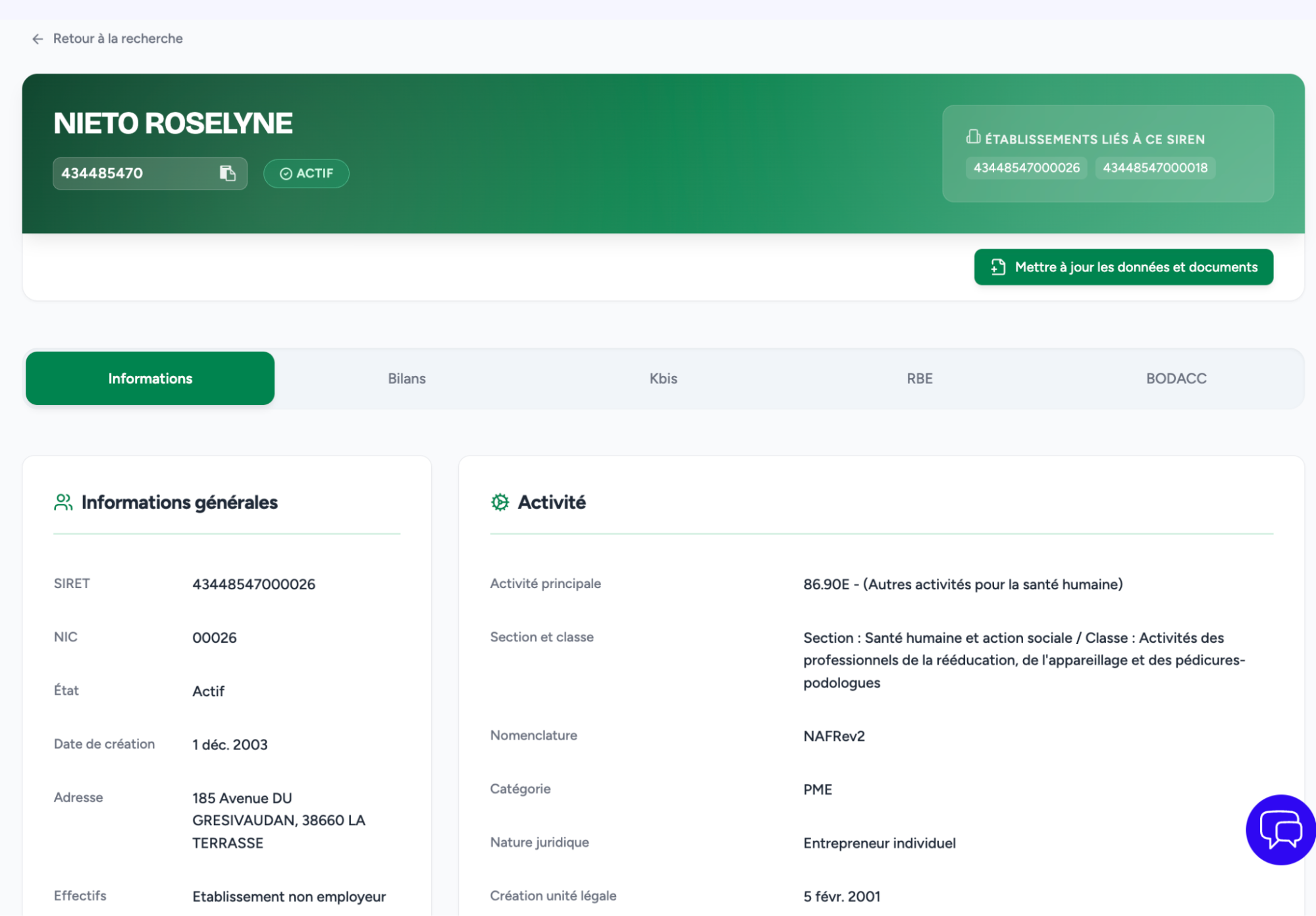
The application also provides a visualization of company locations on an interactive map to better understand the organization’s geographic footprint.
Expanded use cases through an AI exploration agent
Huwise provides organizations with the option to integrate Huwy, its AI exploration agent, enabling business teams to obtain contextualized answers to support and accelerate credit approval decisions. This results in significant time savings and better-informed decisions.
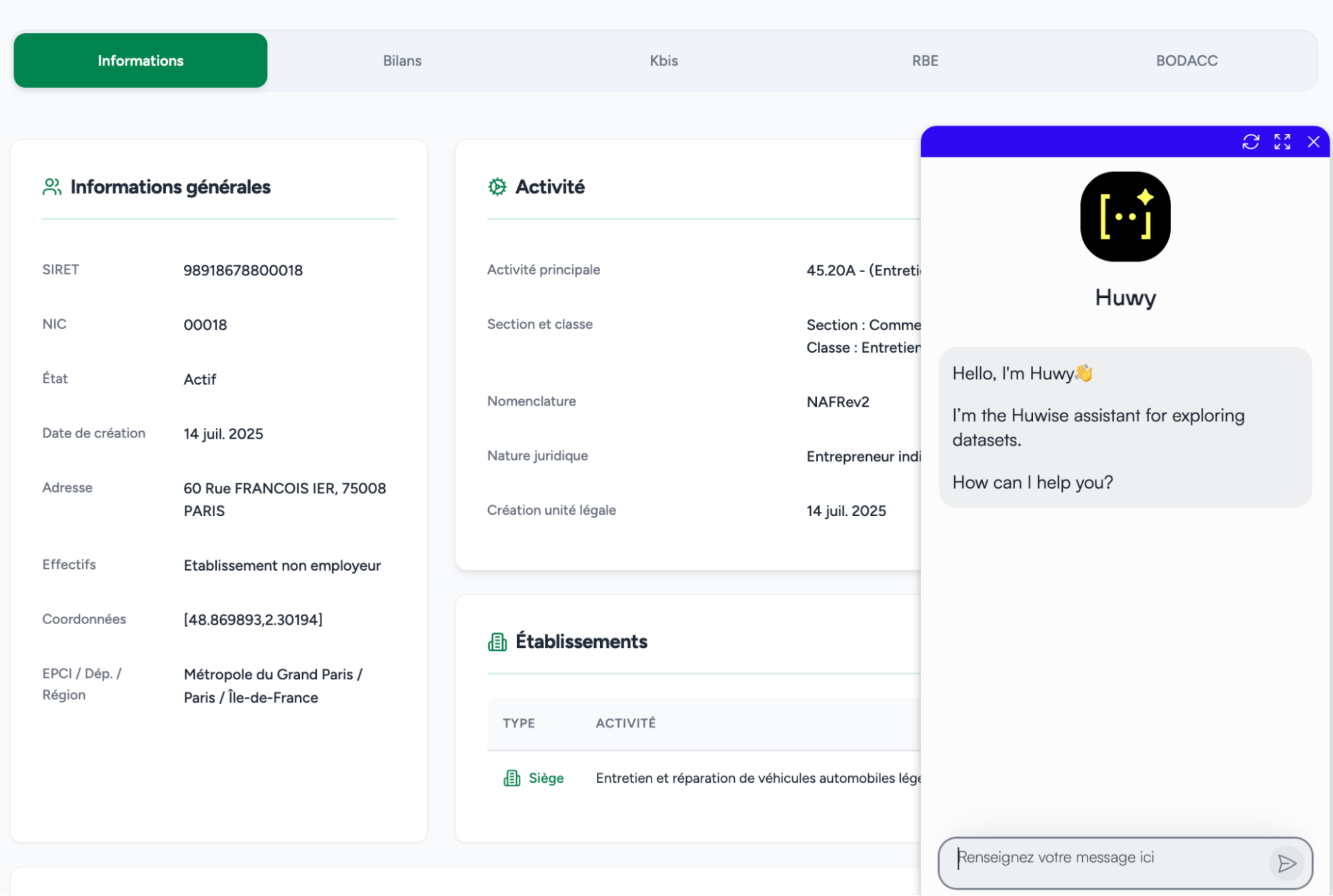
Users can ask questions such as:
- What is this group’s balance sheet?
- Which KPIs should be analyzed before approving this loan?
- What is this company’s debt capacity?
The benefits of data product marketplaces for KYC management
Using a data product marketplace for KYC delivers a range of benefits:
- Simplified multi-source aggregation: the collection and consolidation of data from multiple providers to build enriched, up-to-date company profiles based on reliable and certified sources
- Turning data into a business product: the creation of applications that can be directly used by operational teams and integrated into their daily workflows
- Tailored user experience: customizable applications (branding, business logic, KPIs) that encourage adoption and strengthen user trust
ROI across multiple areas
By centralizing and certifying these data assets within a data product marketplace, organizations transform KYC from an overhead-heavy administrative process into a catalog of agile and reusable data services.
Investing in a data product marketplace delivers rapid and measurable benefits and ROI:
| Category | Key benefits |
|---|---|
| Financial/ ROI |
Reduced operational and data acquisition costs (shared licensing) and accelerated sales cycles |
| Operational | Significant reduction in employee workload for manual entry and verification tasks; faster onboarding times |
| Compliance | Automated evidence archiving for regulatory audits, drastically reducing the risk of fines and litigation |
| Experience | Smoother customer journeys with fewer supporting documents required, improving brand image and data quality through a single source of truth |
Accelerating through AI-ready data
Data product marketplaces provide structured, standardized, and documented AI-ready data that can directly feed fraud detection and risk-scoring algorithms.
This represents a fundamental break from the traditional model, where data teams spent most of their time cleaning and reconciling data before they could even use it.
From raw data to trainable models
An AI model is only effective if the data powering it is reliable, consistent, and traceable. By centralizing KYC sources within a data product marketplace, organizations gain access to certified, versioned datasets that are immediately usable by data science teams. As a result, model training and update cycles become significantly shorter.
Real-world AI use cases for KYC
This data marketplace foundation enables the deployment of high-impact operational applications:
- Fraud and anomaly detection. Models trained on historical financial behavior can identify weak signals, such as unusual ownership structures, sudden revenue fluctuations, and inconsistencies between declarations and market data in real-time
- Dynamic risk scoring. Instead of a static assessment performed during onboarding, AI enables continuous risk scoring that is updated whenever a significant event occurs (management changes, sanctions alerts, changes in beneficial ownership)
- First-level decision automation. Low-risk cases can be processed and approved automatically, freeing up experts to focus on more complex cases that truly require human judgment
Enhanced regulatory monitoring. AI agents can continuously monitor international sanctions lists, regulatory developments, and negative media alerts, automatically enriching the profiles of affected companies
AI as an accelerator, not a replacement
It is important to emphasize that AI does not replace human compliance expertise — it amplifies it. By handling repetitive tasks such as data collection, verification, and initial analysis, AI allows experts to focus on where they create the most value: interpreting complex signals, managing client relationships, and making decisions in uncertain contexts.
This is precisely what Huwy, Huwise’s AI exploration agent, enables: not a tool that answers in place of the analyst, but a copilot that provides the right context at the right moment to support faster and more confident decision-making.
KYC business applications: Build or Buy?
Faced with growing KYC complexity, organizations often find themselves at a strategic crossroads: should they develop their own compliance tools internally, or rely on an existing external solution?
Building internally can seem attractive, especially for large institutions with mature data teams. It offers full control over business logic, tailored integration with existing information systems, and independence from software vendors. However, this approach comes with real costs: months of development time, scarce technical resources allocated to non-differentiating tasks, technical debt that must be maintained, and time-to-market that is often incompatible with regulatory deadlines.
Conversely, buying a data product marketplace allows organizations to deploy operational business applications within weeks, with prebuilt connectors to regulatory data sources, integrated governance, and continuous updates aligned with evolving regulations.The organization can therefore focus its teams on analysis and decision-making.
The real question is not technical — it is strategic. Does your competitive advantage lie in building compliance tools, or in using them effectively? For the vast majority of financial institutions, the answer is clearly the second option.
KYC: from constraint to strategic asset
KYC management is at a fork in the road. Organizations that continue to treat compliance as a manual, administrative obligation will face rising costs, unavoidable delays, and persistent exposure to regulatory failings.
Those that choose to industrialize their approach by leveraging a data product marketplace to centralize, certify, and operationalize compliance data will transform a constraint into a growth driver – a lever for operational performance, a commercial lever through faster client onboarding, and a trust lever with regulators who expect proof, not promises.
In an environment where regulatory requirements around the world are becoming stricter and fraud is growing more sophisticated, AI-ready data is no longer a luxury — it is the foundation of modern, agile, and profitable compliance.
Share this post:
Articles on the same topic:
About the author

Lauréline Saux is passionate about the democratization of data and its impact on society. Through the content she writes, she analyzes the trends and challenges that impact the world of data.
More articles


