

How data product marketplaces enables data team success
Building a successful data strategy relies on having the right roles and skills in place - supported by the right tools. We outline how a data product marketplace underpins your data team, driving greater data sharing and consumption.

To maximize value from data the whole organization must work together. Data has to be freely available and understandable to all teams and AI so that it can be used easily and seamlessly in everyone’s roles. The right culture has to be in place to encourage data use and educate employees on its benefits. Above all, there needs to be a collaborative approach, with data teams, IT and the business, joining forces to share, consume and provide feedback around data and its usage.
Two technologies underpin this collaboration and optimize data value. Accessible, high-quality and trustworthy data products deliver usable, well-governed information to business teams, while data product marketplaces provide intuitive, self-service access to all of an organization’s data products and data assets, acting as a discovery and collaboration space for the entire business.
In this article we explore the role of data teams in maximizing data consumption and value – and how the data product marketplace underpins their success.
Understanding the roles in the data team
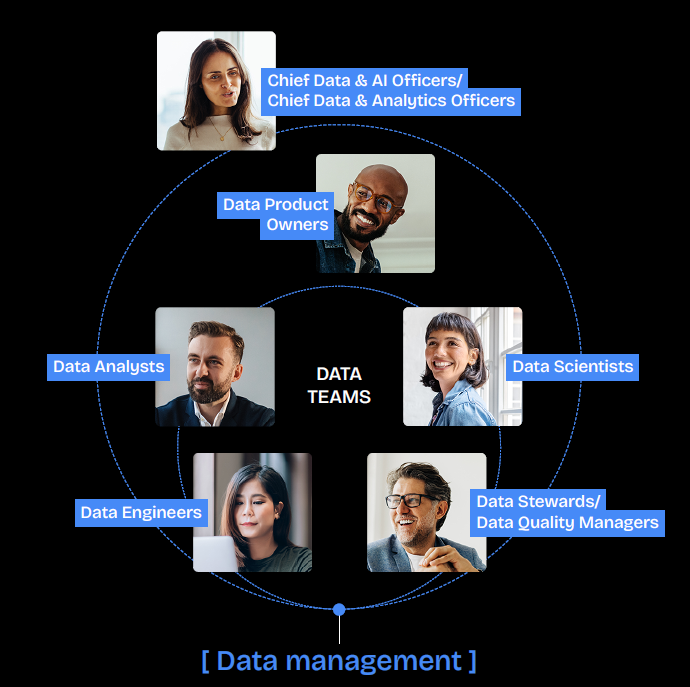
The data management function is charged with overall management of data, including its availability for AI and the wider business, ensuring compliance/governance and security, and most of all maximizing its value by widening consumption.
There are three key sets of roles within the data team – data leaders, data creators, and data operators, all of whom benefit from data product marketplaces.
Data product marketplaces provide intuitive, self-service access to all of an organization’s data products and data assets. Integrating with the wider data stack, they enable seamless, secure sharing of data to all (humans and AI) through an e-commerce marketplace-style experience that provides AI-driven search and discovery and collaboration. Usage of data products can be controlled through granular access management and tracked via data lineage and conversion funnel analytics to drive improvements and maximize consumption.
Data leader roles and the data product marketplace
Data leader job titles include Chief Data Officer (CDO), Chief Data & AI Officer or Chief Data & Analytics Officer (CDAO). Their role is to define the vision for data management
and use, and make high-level strategy and architectural decisions.
Data leaders are responsible for data/data product strategies, governance, AI enablement/readiness, intelligence architecture, and data team structure/model. They have to demonstrate to the organization that data can create value and real business impact. They see data products as a unit of governance and quality and act as the buyers and sponsors of the data product marketplace.
Key objectives for data leaders
Data leaders need to industrialize and scale data consumption, making data reliable and available through:
- End-to-end data management
- Data accessibility and removing departmental and system silos
- Setting and driving a data product approach (ownership, lifecycle, quality)
- Building a data & AI culture
- Ensuring AI readiness
- Providing governed self-service analytics
How a data product marketplace supports data leaders
Data product marketplaces drive five clear benefits for data leaders. They:
- Drive the adoption of data products and other data assets by business teams in a secure and controlled environment
- Demonstrate tangible business value and business outcomes to senior management, preserving and extending budgets
- Underpin scalable AI use cases through access to reliable, well-governed data
- Provide a clear and accessible inventory of business-relevant data and reuses
- Increase discoverability of data products to help business users unlock their value and maximize the impact of data teams’ work
As part of this, data leaders rely on these key data product marketplace features:
- A highly customizable, intuitive platform
- The ability to share all types of data assets, including data products, datasets, documents, AI agents, and PowerBI reports
- Secure, audited access to data for humans and AI
- Conversion funnel tracking & lineage
- Analytics to understand and increase visitor engagement
- Collaboration and feedback loops
- Data product lifecycle management
Creator roles: data product owners and data product marketplaces
Data product owners and managers create and manage the development of data products in line with clear business needs. For this role the data product is a key deliverable in terms of creation and consumption. Data product owners are responsible for turning data into value by creating, monitoring, improving and managing data products and driving their adoption by business users.
Key objectives for data product owners
Data product owners are tasked with widening data usage through the creation of relevant data products by:
- Developing data products from existing data, based on business needs
- Monitoring usage and collecting and acting on user feedback
- Ensuring data products are easily discoverable by humans and AI through structured metadata and consistent templates
- Enforcing security, compliance and governance through smart data contracts
- Continually updating data products to improve fit with business needs and driving increased usage
How a data product marketplace supports data product owners
Data product marketplaces deliver six clear benefits for data product owners. They:
- Support data product creation through data enrichment, metadata templates and the ability to create visualizations without coding
- Provide a centralized, intuitive repository for the self-service discovery of data products and their consumption by nontechnical users
- Enable the promotion of data products to key audiences, encouraging usage
- Allow collaboration with business users
- Provide monitoring and lineage to show consumption
- Support the continuous improvement of data products based on business needs
These key data product marketplace features enable these benefits:
- Granular access management to deliver data products securely to the right users
- Flexible sharing via native connectors, APIs, or virtualization
- Advanced customization to package data products consistently (product page, data consumption tools, previews)
- The ability to easily create visualizations and pages through a drag-and-drop interface
- Multiple data consumption options, including AI-generated visualizations, export, easy-to-explore tables, and pre-configured views
- Seamless integration of glossary terms to simplify data product exploration
- An end-to-end conversion funnel to track usage and boost adoption
- Feedback workflows to support collaboration and improvements (access requests, use cases, feedback)
Operator roles: data teams and the data product marketplace
Through multiple roles, data teams manage data, provide the infrastructure to administer data products and the data product marketplace, and handle day-to-day governance.
Data analysts
Responsible for delivering advanced analytics to the business, data analysts are looking to improve the speed of analytics delivery to the organization and maximize resources.
Data product marketplaces deliver two key benefits to data analysts:
- They enable the seamless, secure sharing of data assets and reports with the entire business
- Their self-service, AI-driven interface lowers workload and requests, freeing up data analyst time for more value-added work
Data analysts are supported by these core data product marketplace features:
- Providing a centralized data space to deliver wider access to data for the business
- The ability to make data available in business intelligence (BI) tools through APIs
- Acting as a repository to collect and publish existing and new reports and visualizations, maximizing their usage
- Integrated AI agents and interactive tools to quickly generate exploratory insights
Data scientists
Data scientists are responsible for using data to create value, including through AI and generative AI models. Their main aim is to successfully deliver AI projects at scale.
Data product marketplaces deliver two key benefits to data scientists:
- They provide access to trustworthy, high quality data to underpin LLMs, generative AI and agentic AI
- They offer an intuitive space to share reports and results after algorithms are created
Data scientists are supported by these core data product marketplace features:
- Access to trusted, ready-to-use and enriched data products to feed AI projects
- They ability to publish data assets, including reports, to the entire business
- Full monitoring and analytics to show performance and drive improvements
Data engineers
Data engineers are responsible for data pipelines, performance, scalability and the definition and enforcement of data product standards. Their main objective is to ensure data availability through seamless management and monitoring of data infrastructure.
Data product marketplaces deliver three key benefits to data engineers:
- They provide scalable sharing of data assets and data products
- They integrate with the entire data/IT stack to provide a central space for data
- They include support for data contracts and data product standards
Data engineers are supported by these core data product marketplace features:
- A wide range of connectors/APIs to import or virtualize data from business applications, data tools, and cloud/storage
- Scalable performance to cope with large volumes of data/data products and usage
- Alerts and notifications in case of issues in pipelines or datasets
- Built-in monitoring and analytics, accessible through existing technical tools
Data stewards/data quality managers
Data stewards and quality managers are responsible for data quality, metadata, and compliance. Their central aim is to deliver and monitor available, reliable, high-quality data in line with corporate standards and processes.
Data product marketplaces deliver four key benefits to data stewards and data quality
managers:
- They support quality and metadata standards
- They provide a full lineage and audit trail for compliance
- They build trust by offering understandable data to the wider business
- They include processors to automate standardization of data to ensure quality
Data stewards and data quality managers are supported by these core data product marketplace features:
- A wide range of processors to enhance data quality, usability, and value, including by combining internal and external data
- Built-in and customizable templates to ensure metadata completeness and quality
- The ability to customize the corporate glossary on the marketplace to facilitate data understanding and a common vocabulary
- End-to-end data lineage to understand object relationships, fix broken links, and safely clean isolated objects
- Role-based access and security to ensure data governance and compliance
The importance of teamwork to data management
Data management teams rely on a wide variety of tools within their different roles. However, often these point solutions are difficult to integrate or share across the wider team. Data product marketplaces are therefore crucial to unifying teams, providing a single solution that supports the entire data team’s objectives through a powerful, secure and user-friendly tool. This enables greater efficiency and collaboration, and drives governed data sharing with the wider business, maximizing data value.
Want to learn more about the different data, business, and IT roles involved in successful data programs? Download our new ebook to get the complete picture.
Share this post:
Articles on the same topic:
About the author

Anne-Claire Bellec has more than 15 years of experience in marketing strategy. She has previously held roles as Chief Marketing Officer and Director of Communication within both agencies and SaaS companies specializing in data and digital solutions.
More articles


