
Huwise deploys agentic framework with usage context layer to amplify the value and impact of data marketplaces
Rollouts of agentic AI are growing rapidly, driven by the potential for agents to act independently to increase productivity and address business challenges. However, for an agent to act effectively, it needs to know what data it should rely on to make the right decisions. Without the right context, it may generate vague or even hallucinatory responses, undermining its promised value. As agents become more widespread, this means context is therefore becoming ever-more critical for them to operate independently.

To meet this increasing need, Huwise is launching its AI agent creation framework. This provides a powerful shared foundation for developing agents tailored to driving data consumption and improving management of data marketplaces. It can be used to build both turnkey agents integrated into the platform and custom agents, specifically designed around the industry, business challenges, and context of individual organizations.
This approach opens the door to a wide range of use cases, with one common objective: increasing the impact of data marketplaces and accelerating data adoption at scale. This article provides a deeper dive into how it works and the benefits it delivers.
Huwise's usage context layer: A knowledge layer based on real-world data product usage
An effective context layer is central to delivering successful AI agents. Definitions of context layers may vary, but they all agree on one point: a high-performing agent needs rich, reliable, and relevant context. At Huwise, our vision of context delivers on what we have been developing over the last 15 years, through key capabilities already built into our platform.
Actionable context enabled by Huwise’s native capabilities
| Context component | Huwise features |
|---|---|
| Usage knowledge | Draws on marketplace usage signals (searches, drop-off points in the user journey, views, or consumption actions) collected through the conversion funnel, built-in analytics, and data lineage, which identifies the most highly connected assets within the ecosystem. |
| Semantics (semantic layer) | Relies on elements such as the business glossary, metadata entered in product pages, and any other information that helps users understand what the data represents. |
| Business rules and context | Can be derived from documentation associated with data products, business rules, and content entered directly by users in the marketplace. |
| User knowledge | Relies on information such as users’ roles, profiles, statuses, or certain attributes retrieved through SSO, enabling agents to better understand who is making the request and in what context. |
Dynamic context powered by knowledge of how data products are actually used
An AI agent may know an organization’s data, its definitions, and its sources. But it doesn’t necessarily know how business teams actually use that data.
This is because business operations are based on rules and shortcuts specific to each organization. Take, for example, the calculation of annual recurring revenue (ARR) within a subscription-based business:
- An AI agent connected to a data catalog or data lake can identify the data available for calculating ARR, without necessarily knowing which source to select or how to combine it according to the organization’s operating processes.
- An agent connected to a data product marketplace has access to additional signals that help it understand which data is actually relevant: searches, user profiles, consumption actions, data combinations, and business definitions. It can therefore identify, for example, that Finance teams consistently rely on the same data product for their ARR analysis, then combine it with a specific source, and refer to a particular business definition to complete the calculation.
This means that the agent moves from “here is data that could be used to calculate ARR” to “here is the data and rules your organization actually uses to calculate it.” Context thus becomes dynamic, enriched by business usage: the agent no longer simply knows that data exists; it understands how that data is actually used within the organization.
A context layer open to the data ecosystem
The context we build relies on current market standards (which evolve fast, and which we track closely) so it stays usable beyond our own platform. This approach is reflected in our collaboration with Atlan, which sees Huwise as an essential partner for capturing usage intelligence and contributing to a more dynamic context layer.
A framework designed to deploy high-performing AI agents, enriched by usage knowledge
Deploying AI agents opens up new possibilities to boost the usage of data via data product marketplaces, both generally and also tailored to customer’s specific business needs. Drawing on 15 years of expertise, the Huwise agentic framework extends the platform’s core technological building blocks, including its APIs and MCP server, to provide a robust foundation for creating and deploying AI agents.
What makes this approach unique is its ability to build on tools and capabilities already designed to leverage data. Agents can therefore be deployed where they can deliver their full potential, at the heart of environments designed to make data discovery and consumption easier.
Turnkey AI agents that turn usage signals into targeted actions
Based on the agentic framework, Huwise has created and embedded in the platform turnkey agents that meet transversal requirements that are common to multiple customers.
Analyzing usage signals is essential to increasing data product marketplace adoption. To make this analysis straightforward, we therefore have developed AI agents specifically designed to guide and maximize the success of your data products.
Examples of Huwise turnkey AI agents
- Marketplace Curator: an agent that continuously analyzes data marketplace usage (clicks, consumption, drop-offs, etc.) and recommends actions to improve the adoption of each data product.
- Opportunity Spotter: an agent that identifies gaps between the offerings available in the data marketplace catalog and user needs, then recommends which data products should be created to address identified opportunities.
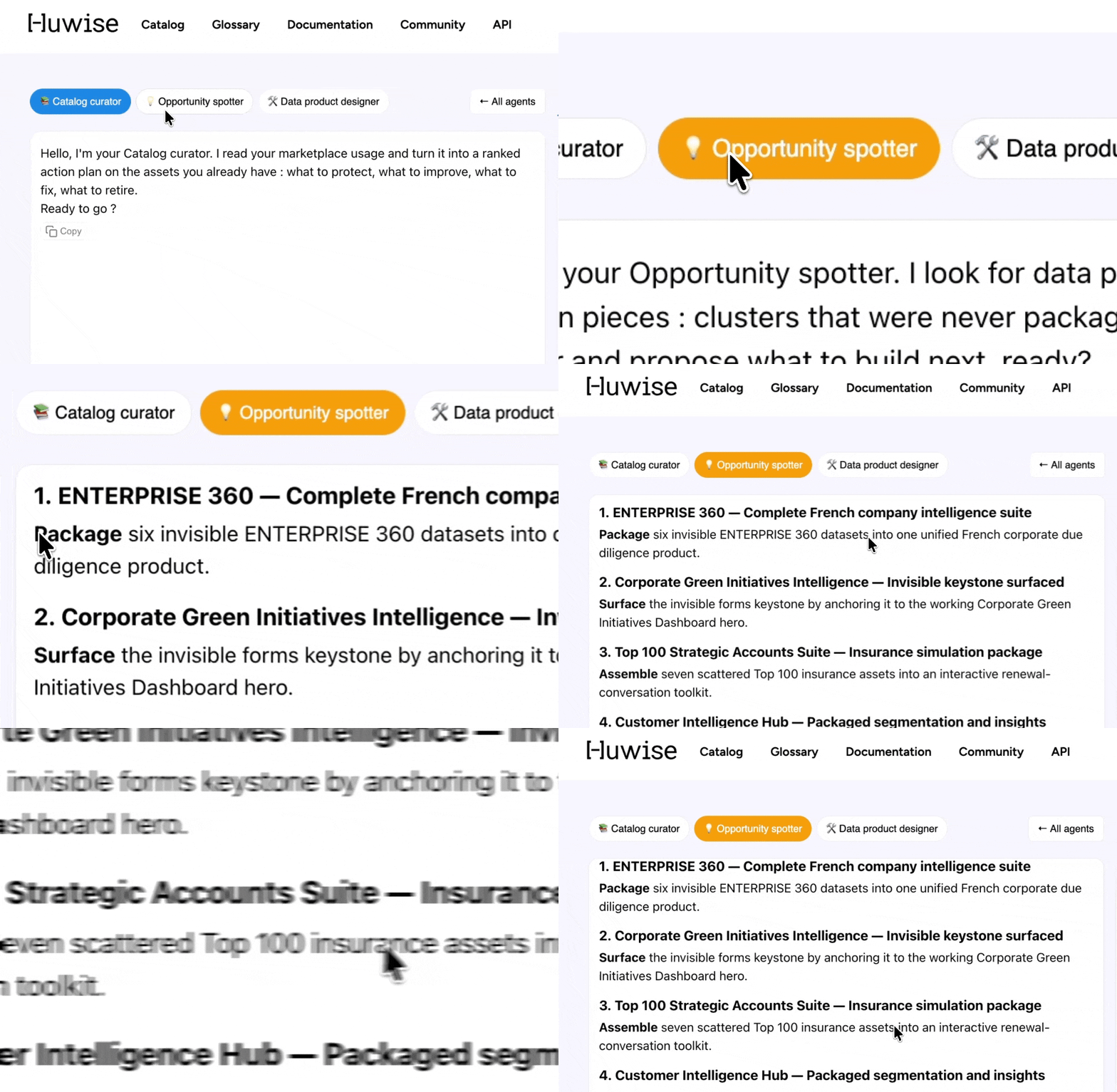
- Data Product Builder: an agent supports the creation of new data products, from identifying and formalizing the need through to their design and packaging.
- Metadata Filler: an agent that recommends updates and additions to fill in missing metadata.
“These turnkey AI agents integrated into Huwise answer 75% of the questions we ask ourselves about managing our data internally.” Customer in the telecommunications sector (200k+ employees)
Mapping usage to provide AI agents with the right framework
Our turnkey AI agents increase the efficiency of data product owners and marketplace administrators, helping them focus their efforts where they will generate maximum impact. They do this by drawing on Huwise’s embedded expertise, represented through a usage matrix that structures and interprets the main signals generated by marketplace usage.

This usage matrix enables dedicated AI agents to transform observed usage signals into targeted recommendations and actions:
- Identifying data products that need to be optimized or promoted and recommending how to increase their adoption.
- Identifying high-performing data products that should be monitored in order to continually optimize them to ensure they always meet user needs.
- Identifying data products that should be deprioritized or removed as they generate little or no usage.
More broadly, these agents enable teams to focus their efforts where they will have the greatest impact, given that as in the wider online world, a minority of products normally accounts for the majority of usage. Data products in a marketplace are no exception to this dynamic.
Custom AI agents to address specific business challenges
A generic agent integrated into a data product marketplace cannot address the individual business needs of all organizations. That’s why the Huwise agentic framework is designed to create AI agents and then adapt them to meet the specific challenges of each organization, whether those involve business rules, scope, data sources, governance, or operating models. Each component of the agent can therefore be configured to precisely reflect the organization’s context.
Because creating AI agents is still new to many organizations, our experienced experts can support you at every stage of the journey, all the way to the design of customized business applications directly integrated into your Huwise data marketplace.
Example of a custom AI agent: the Area Comparison assistant
This agent compares key indicators across multiple areas to support better informed decision-making by municipalities and local authorities.

These initial use cases demonstrate the wide range of roles AI agents can play in helping increase and enrich data consumption. They span custom agents designed to address specific business challenges to turnkey agents integrated into the platform to improve data product performance.
They enable data teams to offload operational and repetitive tasks, saving time on a daily basis. This can then be focused on higher-value activities, such as better understanding business challenges, identifying new innovation opportunities, strengthening stakeholder engagement, and defining and deploying new AI agents to address them.
Data product marketplaces: the only source of live usage context intelligence for AI agents
Context is now central to data roadmaps, both to improve the relevance of AI agents and to increase data value. This echoes Huwise’s vision from day one: making data easier to understand and consume by capturing the signals that reveal how it is being used. By being as close as possible to searches, interactions, and consumption, data product marketplaces therefore provide living usage context that is continuously enriched over time. Huwise intends to continue developing these capabilities to accelerate adoption and make the marketplace the natural start point for data exploration and use.

“We want to go further in collecting and highlighting usage signals, which are essential to delivering relevant context. Our future AI agents will be driven by the feedback and usage patterns we observe. For example, they may be specialized agents or a single agent covering a broader spectrum within the platform. At its core, our ambition remains unchanged: to accelerate the virtuous cycle of usage by making the platform more relevant, attracting more visitors, generating new signals, and enriching the context that AI agents can tap into.”
Share this post:
Articles on the same topic:
About the author

As Huwise’s Product Marketing Manager, Pauline Plancke is focused on continually exploring, analyzing, and communicating the latest innovations in our solution.
More articles


