How data product marketplaces provide usage intelligence to the context layer, driving AI success
Understanding context is critical to ensuring AI agents make accurate, effective decisions. We explain how this need is driving the importance of the context layer - and how data product marketplaces underpin its adoption.

Enabling AI agents is not just about providing them with access to data. To be effective this data has to be understandable and contextualized – AI needs to know which data products and other assets have value and how they should be interpreted within the business.
This context layer goes beyond what data means to capture how it’s actually used – which assets the business trusts, which queries get run, which definitions hold in practice. That usage intelligence makes context dynamic, a living layer that compounds with every interaction. With a context layer, AI agents don’t just understand your data, but also operate on the same governed, continuously improving knowledge graph as your best analysts.
As part of its drive to increase data consumption by humans and AI, Huwise enables businesses to understand and build their enterprise context layer through its data product marketplace. We are working with leading vendors across the data ecosystem to provide this end-to-end context and have now become an Atlan Context Layer Partner, helping organizations to make their context layer complete. This blog explains the benefits of the Huwise approach and our new partnership with Atlan.
Understanding the importance of context
No matter how complete and high-quality raw data is, it is difficult to understand and consume by non-experts and AI agents. There is a risk that it will be misinterpreted or used incorrectly, leading to incorrect decision-making that can damage the business. AI agents increase this risk – as they access data without human intervention, they can inadvertently hallucinate and take biased or wrong actions, which may not be picked up until it is too late.
To overcome these issues, AI agents need more than clean data and consistent definitions. They need a context layer so that every agent has a governed, shared understanding of how your company actually operates.
The semantic layer
A semantic layer is an abstraction layer that sits between raw data sources, such as data warehouses, data lakes, or data pipelines, and the end users or applications that consume that data.
The role of the semantic layer is to present technical data structures in terms of familiar concepts and definitions, applied consistently. In a business this could be financial figures such as revenues or customers. This delivers consistency, but consistency alone isn’t enough. A metric can be defined the same way everywhere and still mean different things depending on who’s asking, what system produced it, whether the underlying data is fresh, and what policies govern its use. That’s where the context layer comes in.
The context layer
The context layer goes beyond semantics. It is the shared infrastructure that sits between your data estate and your AI agents, encoding business meaning, use-case-scoped definitions, lineage, quality signals, and governance policies into a live, queryable graph. Unlike the semantic layer, which standardizes definitions universally, the context layer builds context that is bounded, testable, and specific to how your organization actually operates – while continuously improving as agents interact with it.
In business environments, context is what separates usable data from available, semantically-correct information. Without it, even high-quality data assets can be misinterpreted, misused, or siloed.
Employees working in a business are likely to understand the context behind data based on lived, but undocumented, experience. A finance analyst knows that the Q4 revenue figure in the legacy system runs two days behind the warehouse, so you never use it for end-of-quarter reporting. A risk manager knows that a particular loan category is excluded from the headline default rate because of a one-time regulatory reclassification three years ago. AI agents don’t know any of this. They see the same data the analyst sees, and act on it as if it were neutral and complete. The context layer is what makes that institutional knowledge machine-readable.
Context is specific to the organization – how it thinks, operates, and makes decisions. The context layer is therefore central to creating differentiation and value from the data that organization owns, turning it into deep proprietary insights and intelligence.
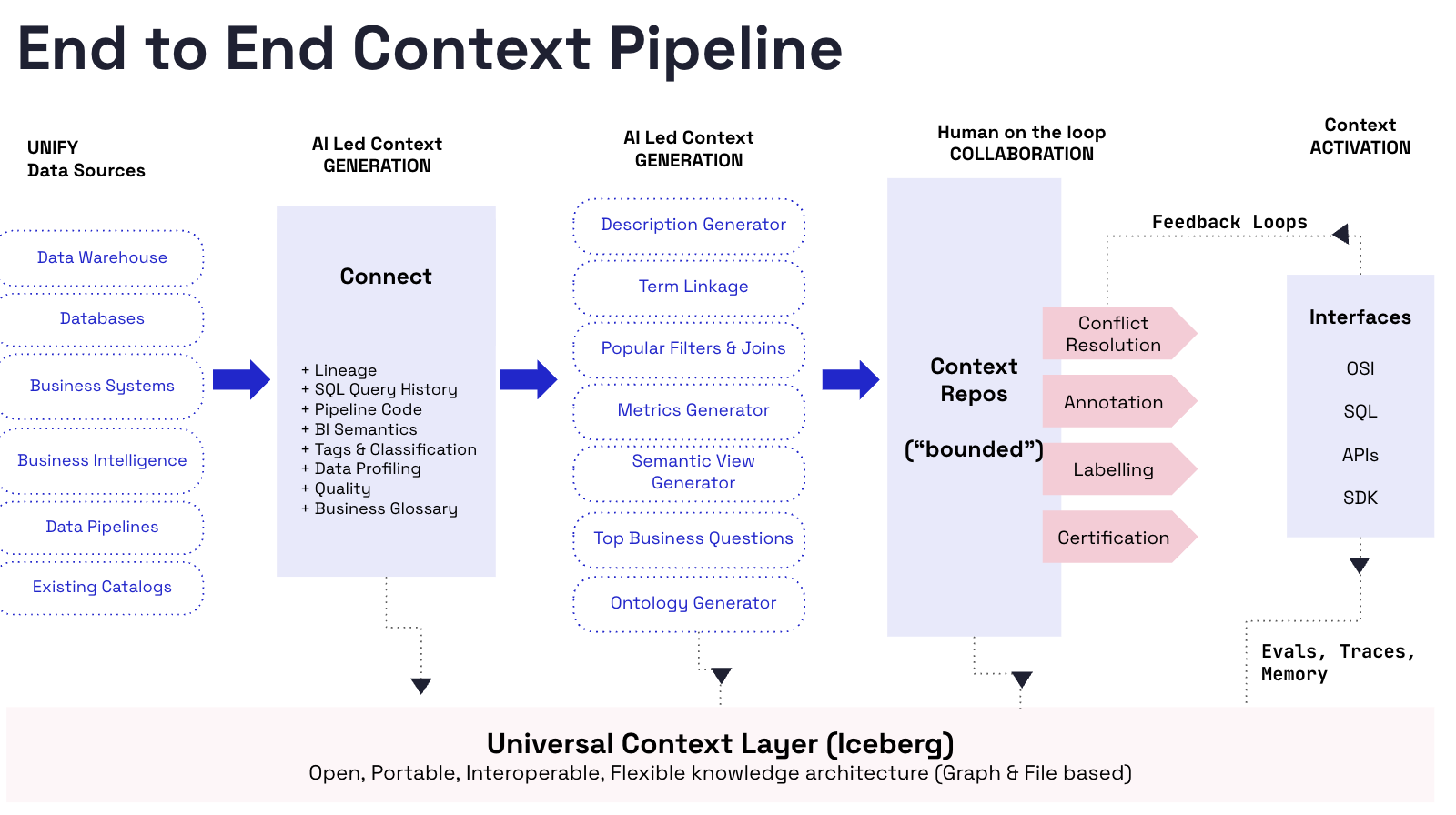
How the Huwise data product marketplace delivers context
Huwise’s data product marketplace provides seamless, intuitive and secure access to an organization’s data for both business users and AI. It builds trust and understanding by enabling users to discover, access and consume relevant data through an AI-driven, e-commerce style interface. It breaks down silos around data, turns it into value, and enables close collaboration between users and data owners.
Without Huwise, users struggle to find and consume trustworthy data, impacting decision-making, performance, and innovation.
Huwise and the semantic layer
Huwise powers the semantic layer through the ability to retrieve and apply semantic layers defined in other tools, ensuring consistency across the data stack.
Huwise and the context layer
Huwise data product marketplaces enable organizations to build their complete context layer by providing the usage intelligence. Built-in analytics and lineage capabilities mean data teams can understand which data is used, by whom, in which context. They can see where it has come from and any transformations or changes made during its journey.
This signposts which data has value for specific use cases, highlighting which data products that AI agents should use. For example, if everyone in the finance team consults a specific data product, then this provides a strong indicator that this should be prioritized by AI.
It also delivers the context around data, automatically and dynamically. For example, if data contains zip codes it can be used to localize results, bringing ontology into the context layer. All of this updates and enriches the semantic layer, breaking down silos and making data more meaningful and contextual for the company’s AI agents.
By providing this usage context to enrich the enterprise context layer, the Huwise data product marketplace creates trust for AI agents, which drives greater business performance. AI agents can confidently understand and use the right information, optimizing their impact and results in terms of efficiency, decision-making and overall performance. It prevents hallucinations and bias, and ensures that AI projects scale effectively from pilot to production.
Building the enterprise context layer - Huwise and Atlan
Chief Data Officers (CDOs) and other data leaders increasingly see the importance of going beyond the semantic layer to deliver context around their data. They need to unify their data ecosystems to complete their context layer and underpin AI agent success.
Atlan is the Context Layer for AI, the infrastructure that gives AI agents the business meaning, relationships, and governance rules they need to act on enterprise data correctly.
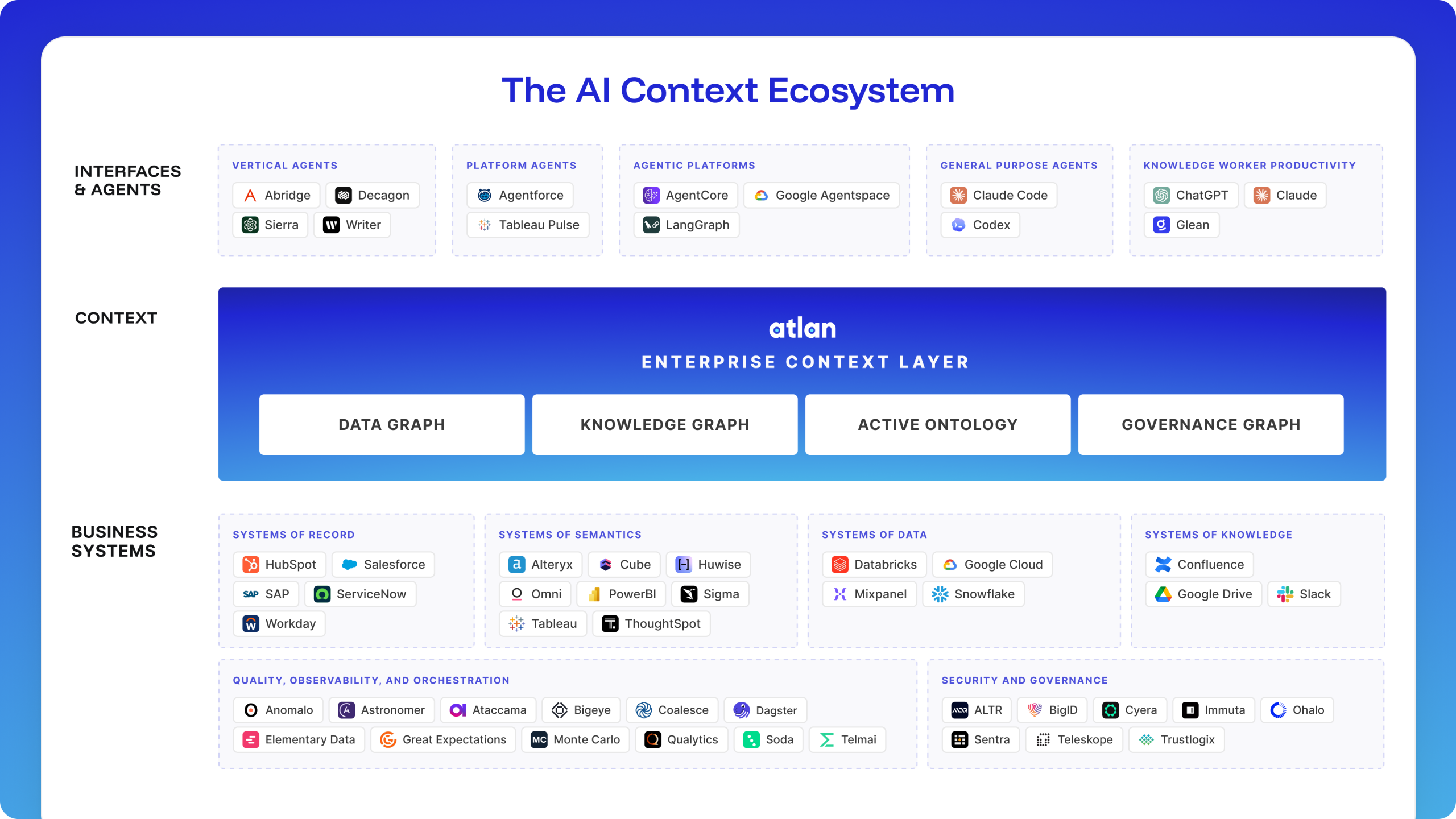
As an Atlan Context Layer Partner, Huwise’s data product marketplace is central to delivering usage intelligence. Working as part of the data vendor ecosystem, it helps make the context layer complete by delivering the business usage information required to guide AI agents to the best data for their needs. The combination of Atlan’s Enterprise Context Layer – unifying lineage, business definitions, quality signals, and governance rules into a single graph – with Huwise’s usage intelligence creates a complete picture: AI agents know not only what data means, but which data has been validated by the business in practice.
Without context, even the highest quality data can be misinterpreted by AI agents. Creating an end-to-end context layer is therefore a business priority for CDOs. By providing deep understanding of usage and consumption, data product marketplaces act as a foundation of effective context layers, helping organizations harness AI and its benefits.
To learn more, join Atlan Activate on April 29.
FAQ
The semantic layer is an abstraction layer that sits between raw data sources and the end users or applications that consume that data. Its purpose is to translate complex, technical data structures into business-friendly terms, enabling non-technical users to query and analyze data without needing to understand the underlying schemas or SQL logic.
The context layer is the shared infrastructure that gives AI agents everything they need to reason over enterprise data correctly — not just what data means, but where it came from, whether it can be trusted right now, what policies govern its use, and how the organization has applied it in practice. Unlike the semantic layer, which standardizes definitions universally, the context layer encodes context that is specific to your organization, testable against real questions, and continuously updated as your data estate evolves.
The Huwise data product marketplace provides advanced usage and lineage information on which data is used, in which situations. This delivers context for AI agents about what data means and which data should be accessed in specific use cases. If every analyst on the finance team consistently queries a specific data product, that’s a strong signal it should be prioritized. Huwise feeds this usage layer into Atlan’s Enterprise Context Layer, making context dynamic rather than static.
Share this post:
Articles on the same topic:
About the author

Anne-Claire Bellec has more than 15 years of experience in marketing strategy. She has previously held roles as Chief Marketing Officer and Director of Communication within both agencies and SaaS companies specializing in data and digital solutions.
More articles