Making data collection simple, fast and AI-ready with Huwise forms
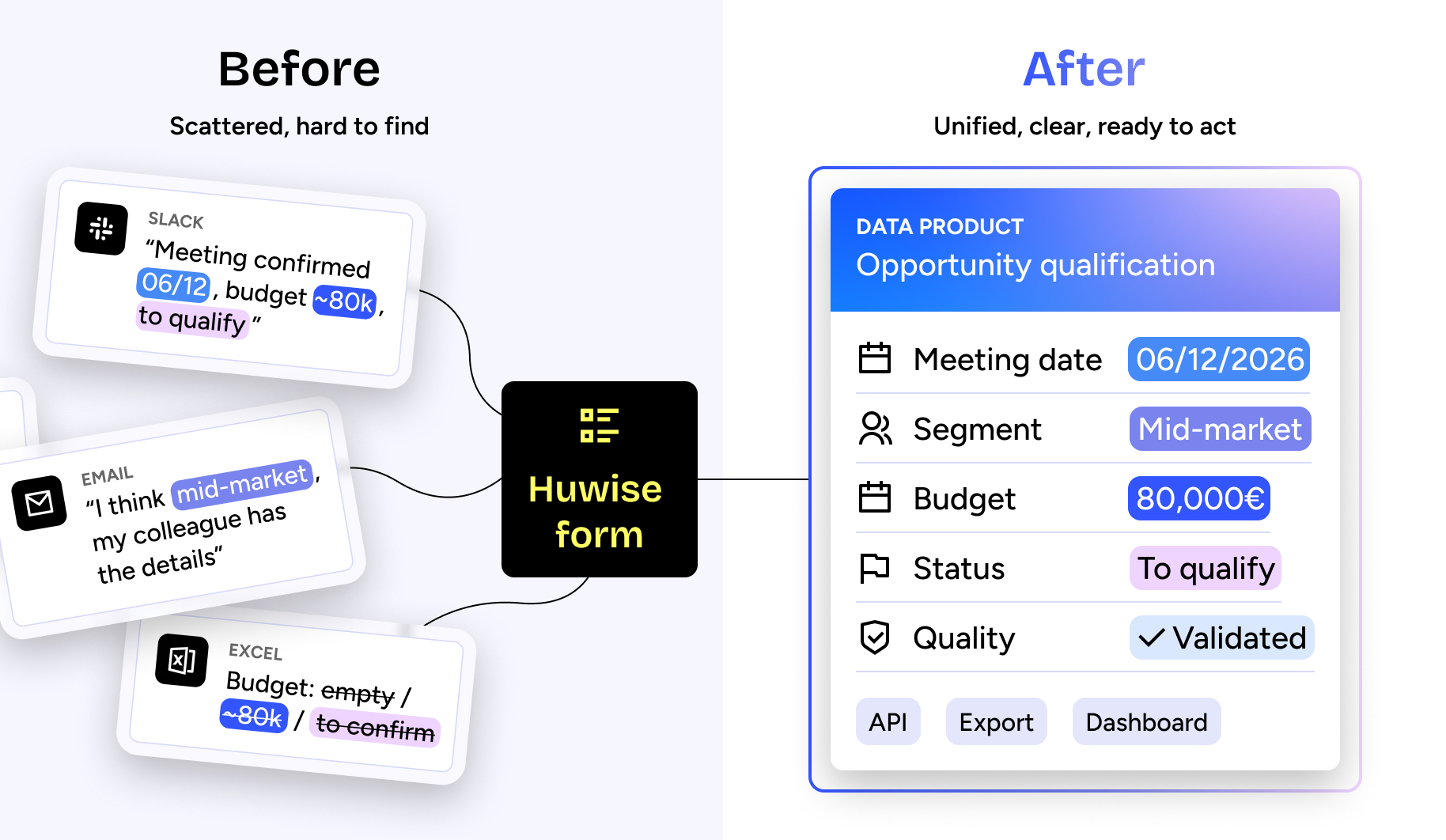
Data is everywhere. Emails, files, business tools, and everyday interactions. Yet it often remains scattered, poorly structured, and hard to leverage. As a result, despite its abundance, organizations still struggle to turn it into reliable, actionable insights, even though this capability is becoming a key driver of sustainable competitive advantage.
As AI use accelerates, the ability to feed it with reliable information is becoming a key challenge. Without this, both models and analyses remain incomplete and the value of data is unrealized.
85% of data leaders surveyed consider quality to be an indispensable prerequisite for any reliable and sustainable AI use
The Huwise forms feature helps overcome this data use challenge. It transforms collection into a smooth, structuring and governed process within a data marketplace.
The problem: a fragmented, passive data collection process
Most business users are solely data consumers. They consult, analyze and exploit information, but don’t contribute to enriching or improving it.
At the same time data teams have to overcome multiple structural limitations:
- Contributed data is scattered across different systems and channels
- Data is in a wide variety of formats that are difficult to exploit
- Consolidating data is a costly, manual process
These challenges slow down the availability of reliable, reusable data and significantly impact the value that it delivers.
The solution: forms integrated at the heart of a data marketplace
What does it look like in practice?
Huwise forms: accelerating the collection of reliable, AI-ready data.
Users contribute via dynamic forms, while producers:
- Centralize contributions
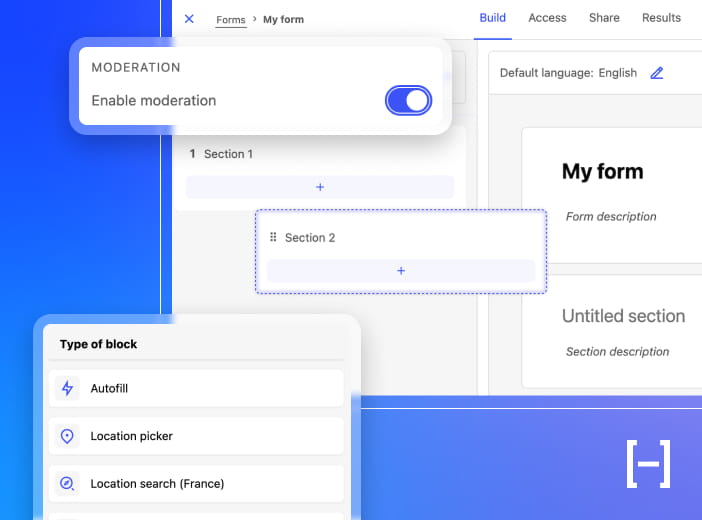
- Apply moderation rules
- Transform collected data into exploitable datasets
With more than 23 available field formats (including text, GPS coordinates, dataset selection, etc.), forms can cover complex and varied business use cases.
Smooth collection integrated into the marketplace
Huwise collaborative forms are integrated directly into the data marketplace. They allow data to be collected within a structured framework, while facilitating user contributions.
They are not limited to information entry: they are part of active contribution and collaboration across the data lifecycle.
Overcoming challenges around structure and AI
Huwise forms help structure data contributions made by workers in the field or from business teams, which are often difficult to collect or are made through informal channels.
They allow unstructured information to be transformed into exploitable data that can be directly integrated into analytical use cases and AI systems.
What is the difference from traditional forms?
| Huwise forms | Traditional forms | |
|---|---|---|
| Specific adaptation to data formats | Yes, 20+ formats available (geographic coordinates, date, file, etc.) | No |
| Rapid transformation of contributions into value | Yes (transformation into datasets or visualizations) | No |
| Moderation and contribution quality management | Yes | No |
| Native links with data marketplace data | Yes | No |
| Automatic pre-filling of information | Yes | No |
| Configurable customizable URL links | Yes | No |
A mobile experience adapted to field use cases
Data collection is not limited to the office. Forms are therefore designed for field and mobile use cases:
- Form access via QR code
- Ability to add photos and attachments
- Pre-filled and contextualized forms to speed up entry
This means data is captured as close to its source as possible, without friction.
Native governance and controls
Forms integrate into the data marketplace’s governance mechanisms:
- User and moderator rights management
- Roles assigned in line with internal policies
- Validation workflows
This guarantees a balance between ease of contribution and ensuring data quality requirements are met.
Concrete use case examples
| Use case | Description | Benefits |
|---|---|---|
| Dataset enrichment | Centralized, moderated contributions directly integrated into datasets | Consumers become active contributors, with data constantly updated and enriched |
| Structured user requests | Requests are captured and standardized via consistent forms | Simplified processing, better prioritization and traceability of needs |
| Collecting data feedback | Users can comment on and rate datasets directly in the marketplace | Continuous improvement of dataset quality and relevance |
| Field data collection | Digitalization of surveys, readings, and inventories via mobile and structured forms | Consistent, reliable and immediately exploitable data |
Key benefits
- For contributors: a simple, fast, and accessible experience
- For administrators: centralized management and controlled governance
- For organisations: more reliable and better structured data
- For business teams: data can be exploited in analytical tools or data products
- For the marketplace: a virtuous circle of contribution and enrichment
Collection forms have become everyday tools for both agents and citizens. We also use them internally to better organize our activities and track our indicators. Synchronization with datasets then allows dashboards to be created to analyze contributions and requests.

Structuring information foundations to address tomorrow's data and AI challenges
Collaborative forms go beyond simple collection: they transform the data marketplace into a living ecosystem where knowledge is continuously enriched and structured.
They allow:
- The collection of emerging, not yet structured data
- The transformation of scattered or tacit information into exploitable data
As AI use accelerates, ensuring that knowledge is structured becomes vital: without this, AI use cases remain limited and the AI model value drops dramatically.
By reconnecting data producers and consumers, Huwise is evolving how the business uses data: from passive consumption towards active, governed and valuable contributions.
FAQ
-
- They enable the immediate transformation of contributed information into data assets on the marketplace, such as datasets or visualizations.
- They offer over 20 collection types adapted to specific data formats (including text, file, map, photo, geolocation and date).
- They provide native links to existing datasets on the data marketplace
- They ensure data quality control via contribution moderation and editing
-
No, everything is done via drag & drop, with no development time or skills required. Forms allow a wide variety of data to be collected, including text, files, GPS coordinates, business identifiers, and structured fields.
-
Once validated, contributions are transformed into datasets or visualizations in the data marketplace. They become directly exploitable for analysis and to underpin AI use cases.
-
Quality is ensured through validation and moderation mechanisms, and governance is managed through access rights in the data marketplace, which determine who can view and exploit the data.
Share this post:
Articles on the same topic:
About the author

As Huwise’s Product Marketing Manager, Pauline Plancke is focused on continually exploring, analyzing, and communicating the latest innovations in our solution.
More articles