
Bloomberg Associates enables cities to harness data to better manage complex construction payments
Major construction projects
Languages
Cities

Company profile
Bloomberg Associates is a philanthropic consulting firm that works side by side with client cities to improve the quality of life for residents by finding solutions to major pain points.
Sector
Local government
Location
United States
Author

One of the areas focuses on is bringing efficiency and transparency to key city processes like construction. Cities around the world spend tens of millions of dollars on large, complex construction projects every year. Getting value for money for citizens is vital. Yetensuring that invoices related to these projects are not overpaid and spotting potential under delivery of work is hard. This creates potential vulnerabilities for public money to be wasted due to mistakes, fraud or abuse.
Challenges: improving scrutiny through smart software
We saw the potential in using data to enable cities to better manage construction invoicing and guard against costly issues.
"At Bloomberg Associates we work with US and international cities to provide greater services for residents, and help cities tackle difficult challenges. We like to find solutions to seemingly intractable pain points. That led us to the idea of the Red Flag project, creating a smart data-driven tool to support human auditing of construction invoices."
Data experience: Delivering a clear data-driven audit trail for construction
We wanted to build a tool that would scrutinize construction invoices and compare them to the complexities of the contract terms, prices and conditions so that before the bill is paid by the city, the tool analyzes it and makes sure that there are no discrepancies or overcharges on the bill.
By spotting red flags that may be missed by human auditors the payment process becomes more secure, faster and digital.
From our experience working with cities on construction projects around the world we had three key objectives for our Red Flag invoice scrutiny tool:
- It had to be fast and simple for auditors to use, supporting them in their jobs
- It had to be multi-language to meet the needs of cities globally
- It had to be able to handle a wide range of data formats and sophisticated processes as they vary in detail from city to city.
Essentially the tool has to be able to bridge between what is happening on the ground and the terms of the actual contract, spotting and flagging any discrepancies. It does this by combing through the contract terms and prices and comparing them to bills to be paid and accounted for. If they match, they are then passed straight through for payment. If not, it raises a red flag to auditors, for deep dive investigation. Often there is a logical reason for the difference, such as material prices changing or a job taking longer than originally forecast. If that is the case auditors can then add a note in real-time to the tool justifying the difference. This provides transparent compliance over projects that often involve millions of dollars of public spend.
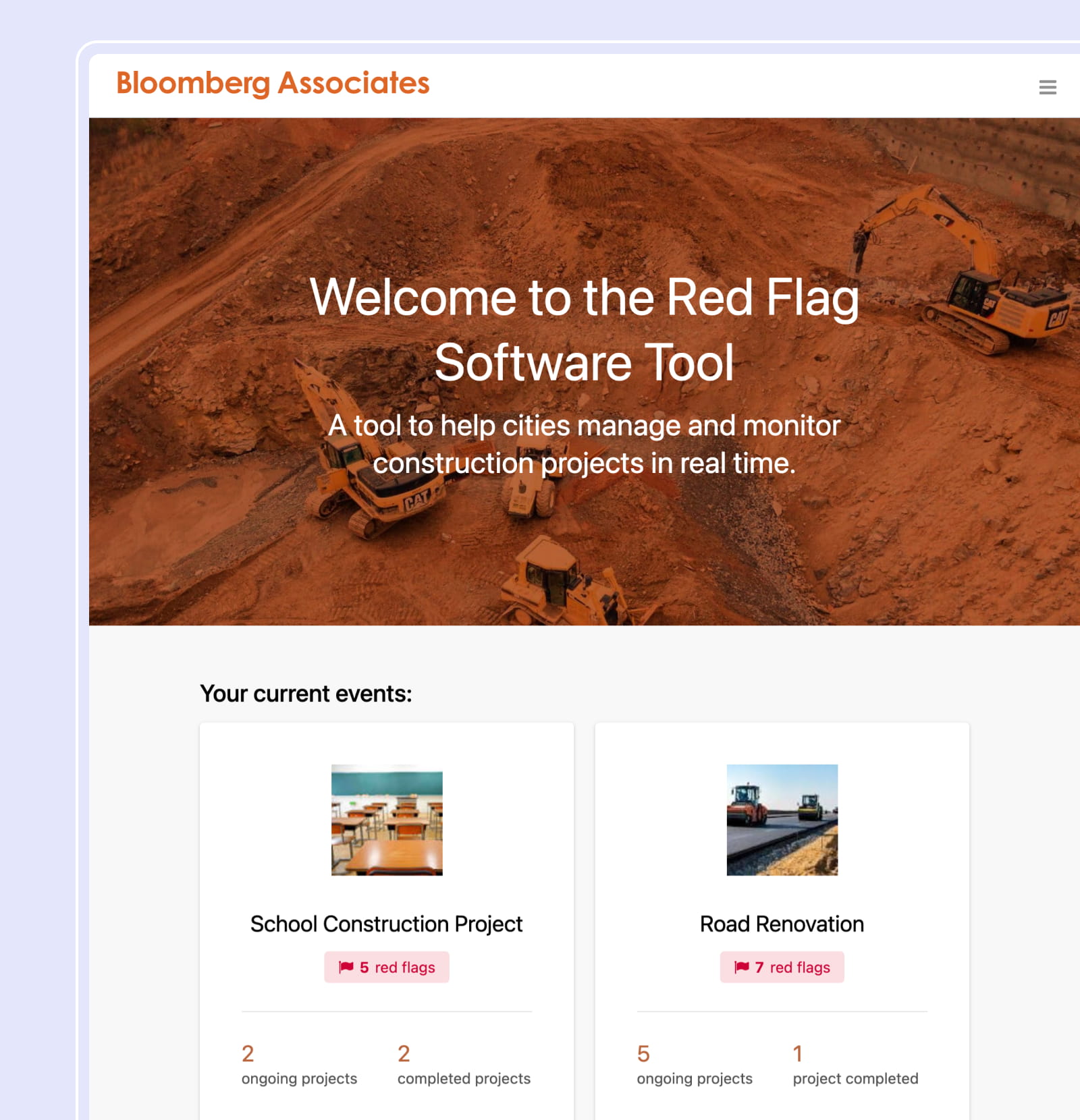
Auditors can view all information through a clear, web-based dashboard that allows them to click on projects and see what has been spent against the contract on a line-by-line basis. Red flags are clearly shown with the ability to comment/clear the flag by adding a full explanation, giving a full audit trail for the future.
The tool was first deployed in 2020 and has been trialed successfully in two cities and two different languages across 18 different construction projects. It is continually being refined through feedback from the cities piloting it. For example, invoices now need to be signed off by the project manager to validate that work has been done when they are uploaded, providing an additional layer of audit strength.
Benefiting citizens through data: A shared approach to turning data into value
Successfully harnessing and sharing data has the power to transform the experience for citizens. Cities often have enormous volumes of data – what is critical is making this available and usable to the right people internally and externally. Often cities are unaware of exactly what data they have and how it can be used more effectively.
Huwise: The Foundation of the Bloomberg Associates Red Flag data tool
After having previously worked with Huwise on open data projects for the City of Paris, we saw the benefits that its technology and approach could bring to the Red Flag tool.
We therefore worked together in partnership to create the tool from scratch, brainstorming the construction invoicing process and building a flexible, data-driven solution based on Huwise’s data marketplace platform. For each new city that adopts Red Flag, Huwise works closely with them to model their processes and data flows, tailoring the solution to their exact needs. Together, we then support the city to roll-out the tool, beginning with specific projects to test its capabilities.
Red Flag relies heavily on three key areas of the Huwise platform and approach:

1. Flexibility to meet every city's needs
Through its open API-based model, the Opendatasoft platform can easily integrate with a wide range of business systems used by cities around the world. It can handle information in different formats, such as from PDF-based invoices, and its flexibility allows the Red Flag tool to follow the city’s individual processes.

2. Multiple language functionality
Every city in the world is involved in construction projects, meaning the Red Flag tool has universal appeal. Opendatasoft’s multilingual platform enables the tool to be provided seamlessly in English, French, Spanish and Italian, speeding up implementation and adoption.

3. Understanding and support
The Red Flag tool relies on a strong partnership between Bloomberg Associates, which brings its municipal expertise, and Opendatasoft’s understanding of data. This is backed up by a strong, ongoing relationship and support for cities as they roll-out the tool.
Results: Delivering a digital double-check to safeguard public money
The Red Flag tool has now been piloted in two cities across the globe, with further authorities looking to trial it over the next year. It has delivered benefits in three key areas:
-
Enhanced peace of mind: Cities using the tool are benefiting from an extra level of scrutiny of construction invoices. This delivers greater security that issues are not being missed by human auditors, providing enhanced peace of mind to cities around construction spending. There is a clear audit trail which shows who has approved invoices, giving full traceability.
-
Spotting potential red flags: In its use across 18 construction projects, the tool has successfully detected a small number of minor red flags. This shows that while existing processes within cities are broadly working, errors will be spotted, enabling them to be investigated further. Use of the tool can also have a deterrent effect, preventing potential attempts at fraudulent behavior.
-
Enabling digitization: Construction projects are complex and payment processes are often still manual. The work around implementing the Red Flag tool encourages cities to better understand their processes and move to digitize them, saving time and money and supporting a more transparent approach to government.

"The Red Flag project demonstrates the value that sharing and reusing data brings to cities, helping them to deliver an extra level of scrutiny for construction projects. Working with Bloomberg Associates is the perfect partnership – bringing together our respective skills and knowledge to solve a real-world, pressing problem through data."
About the Author
Rose Gill Hearn
Principal, Municipal Integrity and Efficiency Practice, Bloomberg Associate
Gemini said Rose Gill Hearn is a highly respected attorney and expert in government ethics who currently serves as a Principal at Bloomberg Associates. In this role, she leads the Municipal Integrity practice, where she advises mayors worldwide on how to promote transparency, prevent corruption, and strengthen public trust in local government.
Let’s talk [ data product marketplace ]
In just 30 minutes, discover how Huwise helps you create value for everyone across your organization. Book your personalized demo with one of our experts and let us explain more.
Book a demo