

Creating data products for all – an interview with Samia Boujatioui, Coface Group
How can data be shared more effectively with business teams at scale? To find out we spoke to leading expert Samia Boujatioui of credit insurer Coface Group, interviewed as part of the 2026 Data Voices Manifesto.
Data has the power to transform organizational performance. However, too often its use is limited to technical experts, either because it is stuck in silos or simply because it is neither understandable or accessible to business teams. Scaling data sharing is crucial to unlocking greater consumption by humans and AI, and driving real value and business success.
Widening data sharing and making it part of every employee’s working routine is therefore a key objective for Chief Data Officers (CDOs) and Chief Data & AI Officers (CDAIOs). To share best practice Huwise’s global Data Voices community has been created to bring together data leaders and provide inspiration to accelerate data strategies.
As part of this, the community has launched the Data Voices Manifesto, which looks at the current state of data sharing and provides perspectives from data leaders on how to transform data management by 2030.
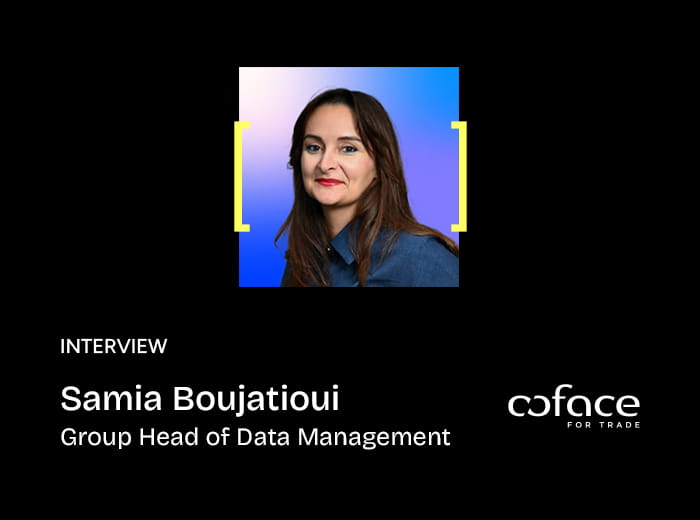
In the second interview featured in the manifesto, we spoke to Samia Boujatioui, Group Head of Data Management at credit insurer Coface. For Coface, whose footprint spans 100 countries, the challenge lies in the ability to transform millions of weak signals – payment behaviors, country risk indicators, and corporate information – into immediate, usable value.
Introducing Samia Boujatioui
Samia Boujatioui is the Group Head of Data Management at Coface, with 18 years of experience in data management and Business Intelligence (BI). She leads strategic initiatives aimed at democratizing data across organizations and turning it into a driver of performance and innovation.
She has deep expertise in data governance, optimization, BI architecture, and data virtualization, as well as a strong understanding and experience of modern approaches such as data fabric and data mesh. Through her work, she transforms complex data into actionable insights and strategic decision-making tools, enabling efficient access and integration across diverse information systems.
At Coface, Samia drives cross-functional initiatives to modernize data practices and foster a data-driven culture. She coordinates multidisciplinary teams from requirements gathering to solution deployment, ensuring alignment with business goals, regulatory compliance, security standards, and operational efficiency. She also oversees service centers and third-party application maintenance, ensuring the sustainability and continuous improvement of deployed solutions.
Active in the data ecosystem, Samia regularly shares her expertise at conferences and in industry publications, helping organizations adopt best practices in data governance and modern architectures. Her work emphasizes making data a strategic, reliable, and actionable asset, supporting digital transformation and empowering decision-makers at all levels.
Samia, how did the concept of the data product shift from an architectural trend to becoming a structural necessity for the Coface Group?
“At Coface, data is the very essence of our business. Today, with the rise of business intelligence, we no longer simply collect information—we create value to support our clients in their decision-making processes.
In this context, the data product, understood as a set of processed, qualified, and packaged data, is no longer optional. It is the foundation that enables us to move from raw data to a strategic asset capable of generating direct revenue through our commercial information offerings and APIs. This shift imposes clear, disciplined best practices: treating data with the same level of rigor as an industrial product, with clear quality standards and full documentation.”
How is the role of the data leader changing?
“The data leader is no longer simply a technical expert who has been promoted. They are the backbone of a multidimensional transformation. I structure my role around three core pillars. First, as a product strategist: I must balance investments and prioritize assets that create immediate value for the business or for the end customer. Second, I act as the guarantor of reliability. AI significantly amplifies the “garbage in, garbage out” risk. My responsibility is to ensure flawless data quality in order to maintain user trust. Finally, I am an ambassador and a coach. We must influence business teams to move away from isolated Excel files and toward centralized platforms. This is how we avoid repeating the pitfalls of 2000s IT departments, which delivered tools disconnected from real business needs. The data leader is the person who reconciles governance rigor with the agility of operational effectiveness.“
How do you reconcile new, decentralized models such as data mesh with legacy systems and the complexity of a large financial group?
“We never start from scratch. We always operate within an environment that already contains significant legacy systems. The goal is not to impose a rigid theory, but to adapt the maturity of the data product to the functional reality of each business domain.
At Coface, we make a clear distinction: a dedicated entity is responsible for external data
monetization (buyer scores, country ratings, APIs), while my role within the Data Office is to industrialize internal data in order to break down silos.
A data product in our organization is defined by having an identified owner, a service-level agreement (SLA), and full traceability. By structuring these internal assets, we avoid redundant calculations and poorly governed data, creating a stepping stone toward true operational maturity.”
How is your semantic layer underpinning your agentic AI ambitions?
“The semantic layer is an absolute prerequisite. Without it, agentic AI is nothing more than a promise that risks multiplying unexpected issues or hallucinations. Our STAR data platform centralizes our internal data.
It enables business users to no longer be passive consumers, but active contributors who shape the product according to their needs. This semantic layer provides the necessary vocabulary and governance: AI agents can connect to it with trust and security.
We deliberately rejected the idea of a technological magic wand. By enabling access to structured and well-documented data, we are laying the groundwork for AI to enhance what already works, rather than trying to mask structural weaknesses.”
Your audit revealed that across your 4,000 Power BI reports, usage was often low. Is the data marketplace a solution?
“The only way to truly empower business teams is to give them ownership. The internal data marketplace we are deploying marks the end of the technology monopoly over data.
It operates like a supermarket of data assets: reports, Denodo views, and metadata. The challenge was not only technical, but also required several years of foundational work to harmonize KPI definitions across all Product Owners.
Today, our ambition is to provide users with smart data: users know who the Data Owner is, they understand the validated definition of each indicator, and they benefit from built-in, region-based access security. This represents a shift from quantity to relevance.”
What are the priorities in your 2026-2030 roadmap?
“My absolute priority remains, and will always remain, the fundamentals: data quality, lineage, observability, and security. AI will only amplify what already works well; it is not a magic wand for structural issues in an information system. I am wary of the race toward AI for AI’s sake. On the other hand, I see new requirements emerging, such as the need to certify the outputs of AI agents.
We will see the emergence of “certifier” roles, capable of tracing data lineage to validate information and decisions produced by an agent. We will also see “agent owners,” just as we currently have data owners. Continued innovation within Coface depends on our ability to avoid skipping essential steps. The history of data in our organization is still unfolding, grounded in a pragmatic vision: technology is a differentiating lever, but semantic rigor is its non-negotiable foundation.
Read the first interview from the Data Voices Manifesto with Michel Lutz of TotalEnergies here, or download the full Data Voices Manifesto to find more expert predictions on the future of data.
Share this post:
Articles on the same topic:
About the author

Lauréline Saux is passionate about the democratization of data and its impact on society. Through the content she writes, she analyzes the trends and challenges that impact the world of data.
More articles


