
The future of data – an interview with Michel Lutz, TotalEnergies
How will data management and AI evolve as we move towards 2030? To find out we interviewed leading expert Michel Lutz of TotalEnergies, a key member of the Data Voices 2026 community
With the rise of AI, data has never been more important to business success. Yet at the same time managing information and making it available seamlessly to both humans and AI agents has never been more difficult. Data is being created more rapidly, in ever-accelerating volumes, across an expanding variety of systems, and is often trapped in departmental silos.
Building trust in data and widening access to information for business teams is therefore an imperative for Chief Data Officers (CDOs) and Chief Data & AI Officers (CDAIOs). To support this push, Huwise has created Data Voices, a global community of Data & Al leaders committed to making data more accessible, responsible, and impactful.
This community has come together to create the Data Voices Manifesto, a document which combines interviews with senior data leaders and the key actions required to build a successful data strategy for 2030.
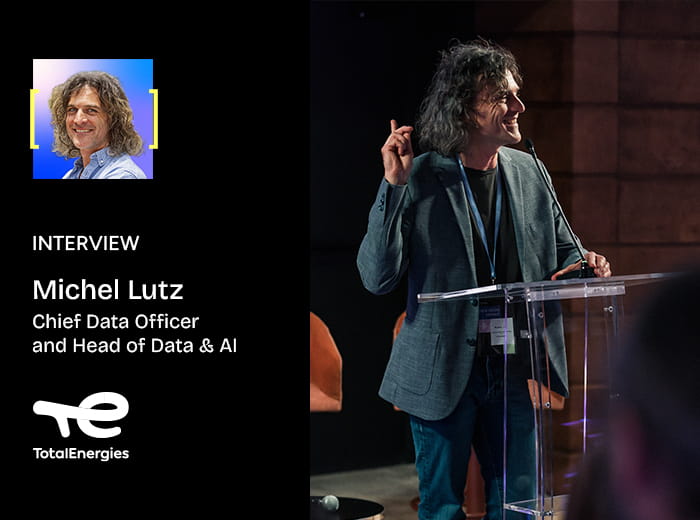
In the first of a series of interviews that are featured in the manifesto, we spoke to Michel Lutz, Chief Data Officer and Digital Factory Head of Data & AI, TotalEnergies, and Ambassador for the Data Voices community 2026.
Introducing Michel Lutz
Michel Lutz is Chief Data Officer and Digital Factory Head of Data & AI at TotalEnergies. He leads the company’s data and AI transformation by fostering a strong data culture and developing team capabilities at all levels. He modernizes technology systems and continuously optimizes data management practices to make data a strategic driver of performance and innovation.
Leading a team of around forty specialists in data science, data management, MLOps, and artificial intelligence, Michel Lutz combines strategic vision, innovation, and operational execution. His work aims to strengthen TotalEnergies’ data maturity, accelerate value creation, and turn data and AI into practical tools for decision-making, operational performance, and innovation.
Recognized for his pragmatic, results-oriented approach, Michel Lutz places data at the heart of the group’s strategy, ensuring it supports business ambitions as well as safety and operational efficiency. His leadership helps make TotalEnergies a truly data-driven company, fully capable of harnessing the opportunities offered by artificial intelligence.
Michel, how do you see the future when it comes to data and AI?
“As a society, in choosing our future digital path we need to make a positive choice where technology becomes a driver for learning, creating, and decision-making together.
We are at a turning point. As with the internet or social networks, AI can become either the best or the worst amplifier of what we do: using it poorly will harm our collective intelligence, while informed use will strengthen it.
This digital transformation has strong similarities with the energy transition: it is a collective responsibility for us all that must help shape society. Just as we choose our energy future, we must choose a digital path that serves humanity.
The goal is to build a positive world where technology does not diminish human intelligence, but instead becomes a driver for learning, creating, and making decisions together.
Our mission is to ensure that artificial intelligence serves human intelligence, while preserving what remains our irreplaceable strength: the ability to think critically, to grasp what cannot be digitized, to create meaning, and to forge a shared destiny.”
How is the role of the data leader changing?
“Beyond their traditional expertise and responsibilities, the role of the CDO or CTO today is also to act as a guardian of common sense and realism amid the current flood of technology and AI marketing. As a CDO, my role is evolving into that of a custodian of pragmatism and critical thinking. I must remind people that technology is not magic, and that it should be used to amplify the talent and potential of all employees. We must invest in this cultural change effort now, because the digital divide will not only be about access to tools, but about the ability to understand and control them.”
"Ultimately, future performance will come from a unique coupling of AI, internal data, and human excellence. This trio will form our true competitive differentiator."
Is it realistic to think that we will soon be able to delegate all data engineering and software development to AI systems?
“The use of generative AI for data engineering and software development is no longer a distant prospect — it is an imperative to improve efficiency. In my role as Chief Data Officer and Head of Data & AI, I actively promote the integration of generative AI into the work of our developers and data engineers. Code is an ideal testing ground for these technologies, which can significantly accelerate certain processes.
We are seeing the emergence of agentic workflows and protocols such as MCP that are radically transforming the way we work. But for this delegation to deliver at scale in an industrial environment where security and quality are non-negotiable, highly skilled IT experts remain essential.
You do not simply install a tool; you design complex systems containing skills, harnesses, and integrations to supervise AI. Human expertise is not disappearing — quite the opposite: it is shifting and delivering differently.”
"Only if the system is properly supervised by knowledgeable humans will it behave as expected."
In your view, what is the greatest long-term risk to knowledge and expertise?
“It is the risk of cognitive dependency. By delegating too much thinking to models controlled by a limited number of actors, we risk weakening our intellectual sovereignty. In the long run, the challenge is real: how do we train tomorrow’s senior experts if we shift toward practices where code is generated or decisions are made without mastering the fundamentals?”
To address this risk, you champion “knowledge engineering” structured around human-machine collaboration. What does that mean?
“I firmly believe that TotalEnergies’ competitive advantage does not lie in the tools themselves — our competitors have access to the same tools — but in our unique ability to orchestrate four pillars of knowledge.
First, there is scientific knowledge derived from our expert models. Then come the company’s internal data assets, whether structured or unstructured. Added to this is what I call statistically compressed knowledge, embodied by LLMs and large-scale models. But the central pivot remains human tacit knowledge — the valuable know-how that cannot be digitized.
The major challenge of knowledge engineering is to build bridges between these worlds.”
"From a data management perspective, metadata, data governance, and the governance of unstructured information become critical to amplifying model performance."
“Organizing the feedback loop is also a key issue. In industrial professions, this process is inherently complex and cannot function without humans playing a fully active role. Without the ability to adjust, contextualize, and reinject business expertise, AI remains superficial. Sustainable performance depends on human-machine collaboration, never on technology in isolation.”
How do you expect AI and business processes to converge in the coming years?
“The ambition for 2030 is to move from localized task augmentation to a genuine redesign of processes, conceived from the beginning with AI as a partner. This also requires designing much more open and interconnected IT systems and technical architectures.
Technology is only part of the equation. Tomorrow’s overall performance will emerge from this unique combination of AI, data, and human excellence. That trio will be our true engine of differentiation.”
Find out more about Data Voices by visiting the community online. Download the Data Voices Manifesto to learn about its 6 strategic predictions for the AI-first organization of 2030.
Share this post:
Articles on the same topic:
About the author

Lauréline Saux is passionate about the democratization of data and its impact on society. Through the content she writes, she analyzes the trends and challenges that impact the world of data.
More articles


