
Five reasons to combine agentic AI and data product marketplaces
Agentic AI offers the ability to embed AI across business processes and increase agility and efficiency. Success requires a focus on data - we explain how combining agentic AI and data product marketplaces delivers transformative benefits.

Organizations today need to operate in ever-more complex markets and environments. Agentic AI enables businesses to cope with this complexity by providing the ability to intelligently automate processes and actions. Agents independently learn and adapt their decisions based on the world around them, delivering both efficiency and agility.
However, successfully embracing and introducing agentic AI requires solid foundations in terms of AI-ready data, strong governance and the ability to deliver context to guide agent decision-making.
In this article we explore how data product marketplaces provide the data and context foundation for agentic AI, and the use cases that benefit from combining the two technologies.
Understanding AI agents
Gartner defines AI agents as “autonomous or semiautonomous software entities that use AI techniques to perceive, make decisions, take actions and achieve goals in their digital or physical environments.”
Agentic AI goes beyond traditional chatbots or AI assistants by providing the potential for agents to learn and take independent actions based on changing conditions. Unlike chatbots, AI agents do not follow a script. They do not simply obey user instructions like an AI assistant. This ability to learn and act in non-deterministic environments makes AI agents extremely powerful, but also brings risks. They can operate independently and make decisions that go against company policies, with actions that are not subject to human oversight.
In a presentation at the Gartner Data & Analytics Summit 2026 London, analyst Frances Karamouzis stressed that most organizations are still in the early stages of agentic AI deployments, with just 8% having agents in production, and 87% either not having started or just exploring/piloting the technology.
Customer facing applications such as CX, marketing and sales are seeing the highest likelihood of current or future deployments, followed by software applications, and IT infrastructure and operations. However, just as with generative AI, organizations need to have the right strategy and foundations in place. Data product marketplaces are central to this, providing access to trustworthy, verified and well-governed data, tracking usage and lineage to deliver a full audit trail and control.
“Seventy percent of agentic AI use cases will fail to deliver expected value due to underinvestment in necessary foundations and poor execution.”
Five agentic AI use cases around data product marketplaces
Combining agentic AI and data product marketplaces benefits five groups – business users of the data marketplace, data owners, data teams, IT, and agents themselves.
Transforming data access and understanding for data consumers
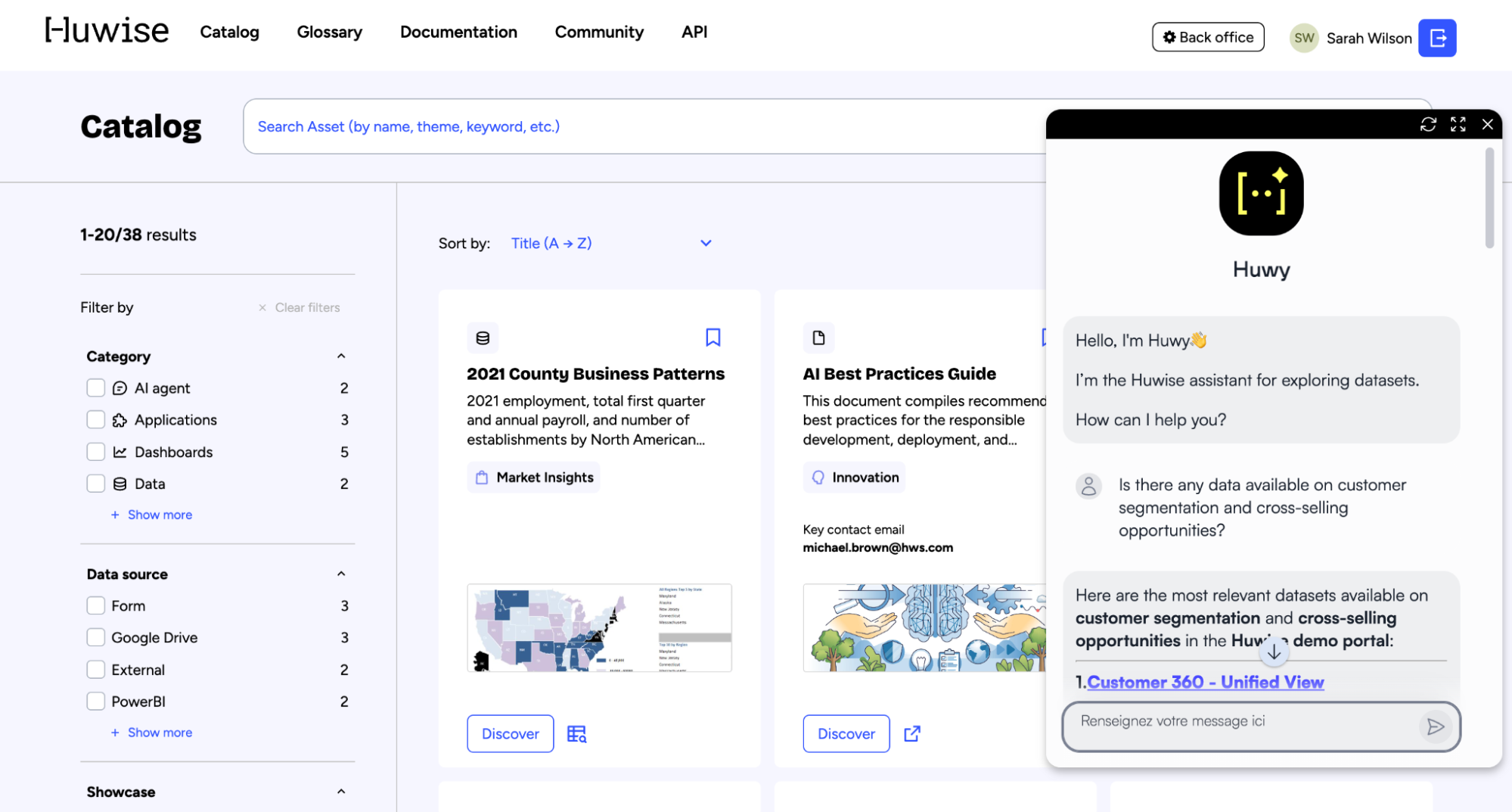
Embedding agents within the interface of the data marketplace provides an additional method for users to find and explore available data. They can simply ask questions in normal business language about the data, building trust and increasing consumption. Users are able to have an ongoing conversation through an agent, receiving explanations about what data covers and what specific terms might mean. Agents can automatically create tailored visualizations based on user prompts, ensuring data is available in understandable formats, while recommending how it can be used and what other data might be relevant.
Huwise’s Huwy AI agent is the perfect example of this conversational agent. Users browse the data product marketplace, ask their question in natural language, type a prompt to interact with the agent, and receive an immediate, contextualized answer directly within their workflow, such as on the homepage, in the catalog, or on an individual product page. Behind the scenes, Huwy is connected to Huwise’s Model Context Protocol (MCP) server. It executes API requests and leverages the full power of Huwise’s APIs to deliver reliable and relevant answers to the user. To widen client options, Huwy is designed to use whichever AI Large Language Model (LLM) clients choose, including OpenAI and Mistral AI.
Providing usage information and improving data products
Data products are not static data assets – they need to be continually monitored and improved to meet changing user needs. Advanced data product marketplaces track usage through the same conversion funnel approach as used on e-commerce websites. That means AI agents can use these insights to highlight where improvements are needed, either on the product itself, in its documentation or its marketing. They can auto-suggest what needs to be done, and even automate improvements, enabling human data product owners to work more efficiently and effectively.

"The value of a data marketplace lies not in the volume of data it contains, but in its ability to learn quickly and anticipate what data is missing."
Automating marketplace administration to free up data teams
Data teams have increasing workloads, and need to focus on their key role of making data accessible to the business to drive improved performance and better decision-making. Data product marketplaces already help this focus by providing self-service business access to data, removing the need for data teams to create reports and visualizations. Deploying AI agents within the marketplace further increases efficiency and frees up time. For example, agents can analyze data marketplace metadata and provide recommendations to optimize its quality or automatically generate clear descriptions of a dataset and its fields to enable easier understanding.
Delivering end-to-end data management to improve IT efficiency
As data volumes and sources have grown, the data management stack has become increasingly complex. Organizations have deployed a range of different tools to handle functions such as cleaning, enrichment, governance, cataloging and master data management. This can make it hard to create, monitor and manage end-to-end data pipelines without requiring significant human involvement.
AI agents are able to automate management, reducing complexity and increasing efficiency. Gartner sees the combination of data management platforms (DMPs) and agentic AI as critical to reducing IT and data engineering workloads. For example, agents can run data engineering operations (such as adaptive pipeline management), monitor, detect and heal data quality issues, automate data governance discovery and enforce security.
“By 2029, agentic data management using adaptive, context-aware Al agents will have automated 75% of data engineering workflows freeing capacity for higher-value reinvestment.”
Unlike traditional automation, AI agents can learn and adapt their behavior as circumstances change, enabling them to be more dynamic and intelligent. Examples of data management AI agents cited by Gartner include:
- Task-based agents that handle specific, discrete assignments, such as fixing errors
- Orchestration agents that manage workflows across multiple systems, such as coordinating data transfers between different parts of the data management stack
- Multi-agent systems (MAS), collaborative swarms of agents that handle more complex problems, such as creating new data products from scratch
Delivering contextual data products to power AI agents across the business
To operate effectively, agents require access to AI-ready data. This goes beyond ensuring that information is reliable and high quality. It must be understandable to agents, both semantically and in terms of context.
Capabilities such as semantic layers translate technical raw data into business-friendly terms, along with business glossaries, which standardize terms across the organization. These help AI agents to understand the meaning of data in business terms, avoiding them potentially misinterpreting information or trying to compare disparate datasets without understanding their underlying differences.
Context covers more than the meaning of data, providing the information needed to interpret it correctly. It goes beyond the semantic layer to also cover governance, lineage, quality, and operational context. It is often stored as metadata, including factors such as who created the data, when, how often it is updated and what it is originally used for. In terms of context, humans can use their experience and knowledge to add this to the data in front of them. AI agents cannot, so a context layer is required to ensure accuracy.
Data products, available via the data marketplace, provide this semantic and contextual information as standard. This means they provide a rich, structured environment that enables AI agents to discover and choose the most relevant data to power their actions and decision-making across the organization. Usage information helps deepen context – for example, if one specific data product is used by 90% of the finance team, this is a strong signal to an agent to trust and consume this particular asset.
The role of the data product marketplace in supporting agentic AI
Advanced data marketplaces, such as the Huwise platform, underpin agentic AI through a combination of built-in MCP servers, AI-ready data products, strong governance, and a context-aware approach that guides AI agents to the best data for their requirements.
- MCP server: The MCP standard provides machine-readable access to data for agents and LLMs, enabling data to be shared with environments such as Claude Desktop, OpenAI, Mistral AI, and Microsoft Copilot.
- Data products: Data products are AI-ready data assets that combine quality and clear documentation, making them easily understandable by both AI and humans.
- Strong governance: Data lineage enables organizations to monitor which data assets are being used by AI agents, providing a full audit trail that integrates with broader data governance tools and processes.
- Context-aware approach: Agents can easily see the business usage of data products and contextual information, ensuring that they are guided to the best data for their specific requirements.
Delivering on the benefits of Agentic AI
Agentic AI promises to transform business operations, providing truly intelligent and agile agents that learn and make decisions based on the changing environment around them. This requires access to contextual, high quality and AI-ready data, along with guardrails to monitor, observe and govern the actions that AI agents take. Data product marketplaces are central to delivering this data, and provide a robust platform to power – and benefit from – agentic AI, helping deploy it across the organization to provide real value.
FAQ
-
An AI agent is an autonomous artificial intelligence system capable of understanding its environment, reasoning about next actions to take, and executing tasks independently to achieve defined objectives. Unlike traditional AI models that require step-by-step instructions, agentic AI exhibits autonomy, goal-driven behavior, and adaptability.
-
A data product marketplace provides the context-aware, AI-ready data products needed to power agentic, delivered through the Model Context Protocol (MCP) standard. Through data lineage it provides a full audit trail of which data specific AI agents have used, enabling transparency and control. Agentic AI operating within the marketplace also improves the experience for data consumers by providing faster, more understandable answers, for data product owners by advising on usage and improvements, administrators by monitoring performance, and data/IT teams by observing and monitoring processes across the data stack.
Share this post:
Articles on the same topic:
About the author

Lauréline Saux is passionate about the democratization of data and its impact on society. Through the content she writes, she analyzes the trends and challenges that impact the world of data.
More articles