

LinkedIn for internal data – lessons from Workday
Companies face a growing demand to provide understandable, accessible and high-quality data to business teams at scale. This requires new tools, such as data marketplaces, along with new approaches that make data sharing seamless and intuitive. Speaking at the Gartner Data & Analytics Summit 2026 London, Farhad Choudhury Senior Director, Enterprise Data & Analytics, at Workday outlined the company’s data sharing journey to date, explaining how it is combining technology from Huwise with a focus on the user to scale data consumption across the organization.
Trusted Data Products for Humans & AI - inside Workday’s data product marketplace
Workday, a leading enterprise AI platform for HR, finance, and IT, serves over 11,500 customers and 75 million users, including 65% of the Fortune 500. With yearly revenues of around $8.8 billion, the company processes 1.4 trillion transactions annually and employs 21,000 people.
Understanding the data journey
Workday began its data marketplace initiative in 2024 as its analytics community of around 10,000 users was finding the process of getting trusted, unified answers to simple business questions very inefficient. For example, if an executive had a query around churn risk, getting an answer involved a complex, time-consuming process. Data was in silos and there were close to 1,000 dashboards in use across the organization. Different functions were spending a lot of time reconciling each other’s data, rather than accessing insights and using them to take meaningful action. Additionally, Workday had also inherited legacy technology that was not ready for the world of AI, or was cloud-enabled. This led to problems with scaling the architecture, both for the volume of data and the number of potential users.
Creating a LinkedIn-like experience
Workday understood that to drive adoption, it had to make its data marketplace intuitive and seamless to use. The aim was to deliver a LinkedIn-like experience for its internal data and analytics community.
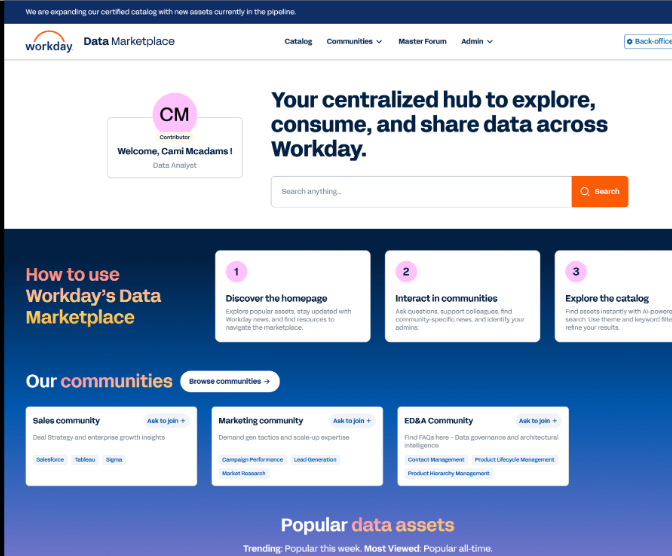
“A data marketplace only creates value when it becomes part of how people work, not just where data lives. The real shift is building a Community where Producers and Consumers are aligned around trusted outcomes, not just assets.”
The importance of trust and community
Workday understood that user trust is not something to be added to a project at the end. Instead, it focused on trust as a foundation that was designed-in from day one, combining a community-led approach for business users and setting context for AI agents.
To build trust Workday looked in-depth at both its data consumers and data producers to understand their personas, and embed their requirements into its architecture.
- Consumers: business users/executives, business data analysts, functional/cross-functional teams
- Producers: analytics engineers, data engineers, data scientists, BI developers, data governance stewards
These are spread across different communities & data domains – Sales & Marketing, CX, Finance, Product & Technology, and HR/Legal. Each of these groups has its own language around data, its own definitions, terminology, and business cycles.
To deliver the data to different personas, Workday relied on three key capabilities. Firstly, strategic alignment and a unified methodology for AI ready data that spanned all functions. Second, it focused on developing community capabilities, such as self-service and cultural change. Underpinning this all is a modern AI- and cloud-enabled technology stack, including copilots for producers and agents for consumers.
Understanding Workday’s technical architecture
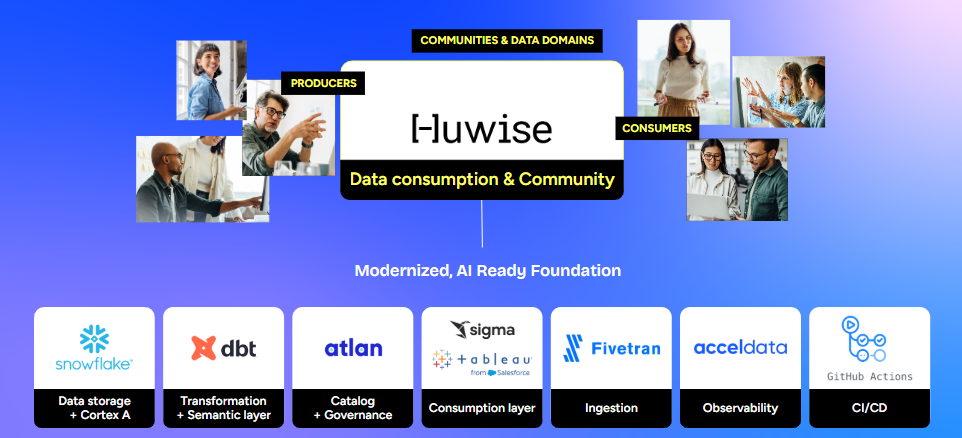
Within Workday’s technical ecosystem, the Huwise data marketplace solution provides a central, enabling capability that brings everything together and enables people to access data from a range of systems, including Snowflake, DBT and Atlan. The data marketplace enables Workday to customize and create specific experiences for its different personas, while providing a central data destination for all of its employees.
Key capabilities of the data marketplace
Consumers and producers interact across the Workday data ecosystem, with the data marketplace enabling the company to understand what each of its personas need and make that easily accessible through a single data entry point.
Data discovery and search features
Intelligent search helps users both find certified data analytics products, and also see what’s going on in their community. Searches return relevant data products, analytics products, and AI agents that can help answer a question, or add information to a specific data product, alongside community news.
Persona-based experience
Within the marketplace, Workday is aiming to create persona-based For You pages, showing updates from the user’s specific community, including what is currently trending. This will be based on understanding different communities, and the data created and shared within it.
The goal with each community is to be transparent and make everything accessible, in a single place. People can post questions, answers, share articles, and share showcase items, making it accessible globally to the entire community. The aim is to ensure that the marketplace is a focus for collaboration, moving data discussions into one place with community administrators validating and certifying the questions, the answers, and the data products. Workday’s goal is to make everything digitized, visible and searchable and help reinforce collaboration and the underlying trust in data.
Next steps for Workday
Currently, the marketplace is in a pilot phase with about 100 users, with plans to scale to 1,000 by year-end and eventually to 4,500–10,000 users, targeting the sales, marketing, and finance teams within Workday. Future enhancements include expanding community engagement, based on user feedback. Alongside this Workday is focusing on embedding and leveraging agent capabilities to provide a conversational agent that can search the marketplace, as well as analytics agents that can respond to questions and signpost users to the right information.
Focusing on the user experience is essential for businesses looking to scale data sharing across their organization and with humans and AI. Workday’s journey demonstrates how adopting a persona-based approach, and delivering data through a collaborative, intuitive and self-service LinkedIn-style experience is central to increasing engagement, consumption and collaboration around data.
Want to learn more about how Huwise can help you build a personalized data marketplace that connects data producers and consumers? Arrange a call with our experts to discuss your data sharing plans.
FAQ
-
A data marketplace is a centralized data platform that makes available all relevant data. It provides an intuitive, self-service experience, based on e-commerce marketplace principles that make discovery, access, and consumption of data products simple and seamless. Capabilities such as AI-powered search and comprehensive metadata connect users easily with relevant data. Clear descriptions of data products and other data assets, including details of their owners, build trust and confidence, while security and governance is enforced through granular access controls.
-
Workday is a cloud software platform designed for large enterprises, specializing in human resources, finance, and IT management. It is the key solution HR directors use to manage payroll, recruitment, and career development, and that CFOs rely on to oversee budgets and forecasts.
Founded in 2005 in the United States, Workday now serves over 11,500 customers worldwide, including 65% of Fortune 500 companies. It has over 75 million users and annual revenues of approximately $8.8 billion, making it one of the most established players in enterprise management software.
-
A data marketplace is not just about technology – it is first and foremost a space for collaboration around data. Without active community engagement, the marketplace risks becoming little more than a data library that no one uses.
Community engagement is the engine of a successful data marketplace. Users validate and certify data, ensuring its reliability; they drive adoption by sharing experiences with their peers; they identify and feedback on gaps to continuously improve the experience; and maintain an ongoing dialogue between producers and consumers to ensure data consumption and value. Technology provides the foundations, but it is the community that brings the marketplace to life.
Share this post:
Articles on the same topic:
About the author

Anne-Claire Bellec has more than 15 years of experience in marketing strategy. She has previously held roles as Chief Marketing Officer and Director of Communication within both agencies and SaaS companies specializing in data and digital solutions.
More articles


