Data quality as a business enabler – an interview with Camille Maire, ETAM Group
How can organizations ensure their data is reliable, high-quality and AI-ready? Technology alone isn’t the answer and must be combined with cultural change, as Camille Maire of retailer ETAM and our Data Voices community explains.
To be used effectively by humans and AI, data has to be reliable, high-quality and easily understandable. Without these foundations data simply will not deliver value, and data teams will be seen as a cost, rather than a driver of innovation and improved business performance.
Focusing on data quality is therefore an essential part of the role of Chief Data Officers (CDOs) and Chief Data & AI Officers (CDAIOs). However, quality requires more than the simple application of technology. How can they ensure data quality and governance standards are met in order to drive consumption?
To help share best practice on data quality and other key topics, Huwise has created the Data Voices community. This brings together data leaders from around the world, providing inspiration to accelerate data strategies. To provide practical support for CDOs, the community has launched the Data Voices Manifesto, an in-depth study which looks at the current state of data sharing and provides perspectives from data leaders on how to transform data management by 2030.
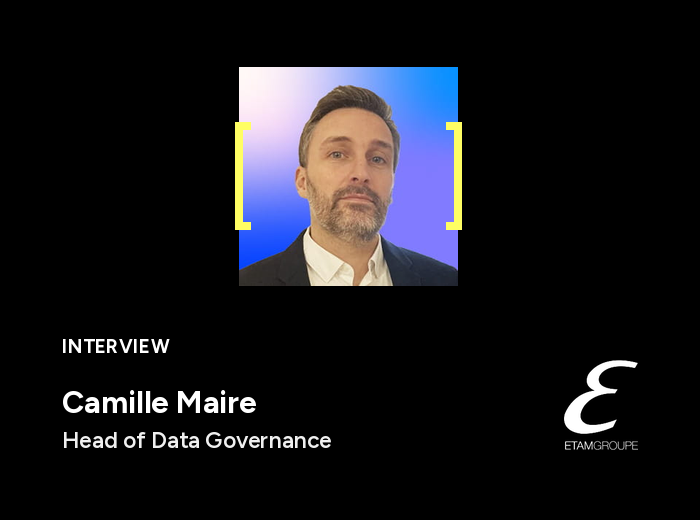
In the third interview featured in the manifesto, we spoke to Camille Maire, Head of Data Governance/MDM/ Data Quality at lingerie and fashion retailer ETAM. With a history stretching back over a century, and 1,300 stores in 57 countries, ETAM aims to create a data-driven culture built on strong quality and governance pillars.
Introducing Camille Maire
With a twenty year career dedicated entirely to data, Camille Maire has established himself as a recognized expert in data governance and the strategic management of information.
After assessing the impact of major regulations (EMIR, MIFID2, Basel) on the data lifecycle, he has specialized in designing and deploying Data Offices. He has helped structure the data function within major groups such as AXA, Safran, La Poste, Crédit Agricole CIB, and CMA-CGM. As Head of Data Governance for the ETAM Group, he now oversees the retailer’s data strategy, governance, data quality, master data management, and the promotion of a data-driven culture.
His approach combines technical rigor and operational leadership. He works with executive committees, business units, and technical teams to turn data into a lever for innovation and decision-making, ensuring security, GDPR compliance, and the adoption of best-in-class tools (Collibra, Snowflake, Tableau). Camille excels in multicultural and complex environments, where he combines strategic vision and execution capability to deliver sustainable business value.
How is the role of the data leader changing?
“Today the data leader is the essential link between business and IT. There was a time when the data leader was primarily a communicator, a project-manager-type profile handling political and budgetary aspects at the early stages of data offices. Today, the balance has shifted. Strong technical literacy is required—even needing actual data analyst or data scientist experience. Why? Because technology is evolving too quickly. You must be able to continually demonstrate full understanding of a constantly shifting technological landscape. To remain credible and strategic, the leader must understand what is happening under the hood. At the same time, this evolution brings a continuous challenge of simplification. The data leader must adapt technical concepts so that they engage diverse audiences, speaking equally to FinOps experts, frontline staff, and senior leaders. It is this ability to translate complexity into a coherent vision that underpins the legitimacy of their role.“
How do you manage the fact that legacy systems are now expected to perform at AI speed in real time?
“It is a constant battle because it is difficult to get business teams to fully adopt their role as data owners. IT is only an enabler: it identifies points of failure, but it cannot validate content instead of operational teams. We can endlessly discuss governance frameworks, but operational reality always brings us back to one issue: who does what?
Today, employees only perceive quality at the end of the chain, through the distorted lens of reporting. When two reports diverge, people blame the tool, whereas the real issue lies deeper in the underlying data. Continuous education is required to explain this. It is more a matter of culture change and documentation rather than purely IT systems.”
Is AI really the ideal excuse to put quality back at the center of operations?
“To be completely honest, AI is actually making things harder for us. We see vendors telling overblown stories and making unrealistic promises to business teams. For example, it would be a mistake to believe that simply purchasing a Claude license would automatically fix defective retail store data. Companies may be tempted to prioritize rapid delivery and shiny innovations over accuracy and security. My team’s role is to remind everyone that if we feed garbage into a model without proper control indicators, we will not obtain anything truly usable as an output.“
How does poor data quality impact a company?
“It is common to see two indicators diverge depending on whether you look at a point-in-time view or historical data. For end users, the verdict is immediate: the report is considered incorrect. The BI tool gets blamed even though the real issue lies deeper — in the source data and the lack of shared documentation. Data should not be perceived solely through the distorted lens of one consumer or one system manager. It is a complete value chain that must be visible and understood by all stakeholders. If this issue is not addressed at the source, frustration builds up and blocks innovation, because nobody wants to build on unstable foundations. This reliability requirement is the essential prerequisite for any meaningful discussion about AI.”
To deliver quality, what should be done, and how should responsibilities be distributed?
“Believing that innovation can happen through a new system without addressing the fundamentals, upstream processes, and legacy systems is an illusion. If the entire process, from data entry to data consumption, is not considered, new systems will merely reproduce or amplify existing errors. The role of the data leader is therefore to act as a facilitator, identifying process flaws and helping everyone across the organization understand that the technology system is only the endpoint of a larger value chain.
For this to work, the three pillars of accountability, processes, and IT systems, must be in place. If one of these pillars is missing — especially business accountability — the tool becomes useless. Data leaders should hold a central decision-making role because every tool acquired directly impacts system integrity. Without this framework, data leaders end up acting as policemen, regulating AI-related drift.”
What are your priorities for your 2026-2030 roadmap?
“Assigning data ownership remains a constant battle. My core focus remains governance foundations and the assignment of domain-level data owners. This is often invisible work, frequently perceived as a waste of time, but it is absolutely critical. I also strongly believe in natural language as an abstraction layer. In the long term, we can imagine a single entry point where users query the entire information system, optimizing processes without seeing the underlying complexity. We already do this for application prototypes,the leap to data is no longer so large. But to scale effectively, I have to continue to defend and promote this invisible work.
My objective is to strengthen master data, because this is where continued innovation is at stake. The success of tomorrow depends on our ability to make these structuring activities visible, as they are essential to the reliability of everything AI will produce.”
Want to learn more? Read our interviews with:
Alternatively download the full Data Voices Manifesto to find more expert predictions on the future of data.
Share this post:
Articles on the same topic:
About the author

Lauréline Saux is passionate about the democratization of data and its impact on society. Through the content she writes, she analyzes the trends and challenges that impact the world of data.
More articles